 February 18, 2026
 In 2026, is any brand relevant if it does not offer personalization? And, we don’t mean the annoying sort; we mean AI personalization, which can identify the unique preferences of your customers.
According to McKinsey research, 76% of customers get frustrated when brands don’t deliver personalized interactions.
Marketers, take note.
You may have noticed that Netflix has this uncanny ability of knowing exactly what you want to watch next. Spooky almost.
They have set the industry standard. And, the good news is that you can achieve this Netflix-level AI personalization in marketing with the right tools and industry best practices.
If you plan to deliver personal experiences on a large scale (to thousands of customers), it’s just not possible the old-school way.
With that in mind, let’s take a deep dive into the scope of AI personalization, the ROI it can bring to your marketing efforts, the challenges, and the key steps to implement it.
What is AI personalization?
To put it simply, AI personalization is a strategy that leverages AI (artificial intelligence) technologies to highly tailor a brand’s marketing messages, services, and product recommendations for individual customers in real time.
This is not limited only to websites and social media. AI personalization can impact a host of digital touchpoints, such as search engine results, in-app messaging, personalized email campaigns, dynamic pricing, chatbot interactions, and so forth. To understand this better, we can look at Loop Marketing, which is HubSpot’s four stage playbook. It is an AI-driven framework created to replace the linear marketing funnel with a cyclical, self-optimizing process.
Human marketers and AI work together to:
1. Express: Define your brand identity
2. Tailor: Use AI to personalize your messaging
3. Amplify: Scale high-performing content across channels
4. Evolve: Test and optimize continuously before looping back again
What does AI Personalization involve?
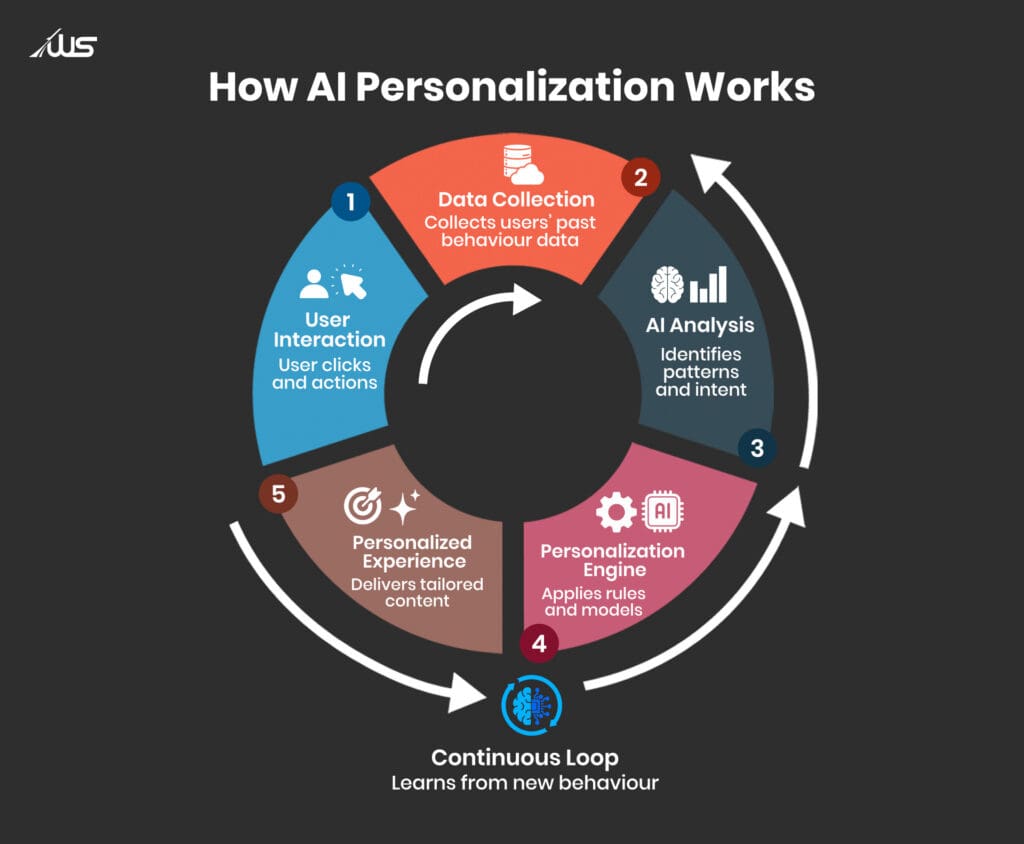
Apart from tracking the past behavior of your audience, AI leverages ML (Machine Learning) and NLP (Natural Language Processing) to figure out the intent, context, and sentiment of your users.
To do this, the AI system looks at signals such as:
- What users click on
- How long they stay on a page
- How far they scroll
- What they search for
- When they are active (time of day)
- What device they use
- Their geographical location
- Hover time and on-screen interactions
- The path they take through a website or app
- The language and tone they use
- How often they interact or return
How AI Personalization Works
What are the Benefits of AI Personalization?
1. Customer experiences that feel individualized and well-timed
People experience your product or website as if it’s made just for them. That’s the power of AI personalization.
In traditional marketing, everyone sees the same marketing message. But, using AI, each customer sees content that aligns with their specific context and unique needs.
It is this sense of relevance that makes the brand interactions feel smoother and more intentional.
2. More meaningful engagement, not just more clicks
When people are shown information that matches their needs, of course, they will stay longer and interact more naturally.
The best part is, you would not need to push your content aggressively.
Since the friction is already removed, you are essentially delivering a message to those people who genuinely want to see it. This is why they interact with it without any nudging from your end.
3. Higher conversion rates
According to a McKinsey report, the companies that use advanced personalization experience 10–15% higher sales.
This is not far-fetched.
Look at it from a customer’s perspective. You would not have to open filters or sort through dozens of options. The products shown already match what you are looking for. You spend less time comparing and move straight to a decision, which makes a purchase far more likely.
4. Smarter use of time and budget
Apart from transforming the customer journey, AI personalization can do all the tedious and time-consuming work for your business.
Through AI marketing automation, your system can do repetitive work like segmenting audiences, adjusting campaigns, and also updating recommendations.
This way you don’t have put in a lot of effort while at the same time you can save acquisition costs.There are a lot of strategic, high-value tasks that your team can work on, rather than constantly reacting or manually tweaking campaigns and so on.
5. Data-based insight into what actually drives value
AI systems are designed to surface data patterns that would have been hard to see otherwise.
This data-driven personalization gives you a clear picture of which users return and what exactly triggers engagement.
AI, for instance, may notice that when your visitors read pricing pages twice and return within a week, they are the ones who convert. You can then prioritize follow-up content and reminders for that group instead of spending the budget on first-time visitors.
Steps for AI Personalization in Marketing

In order to create unique, real-time customer experiences wherever people find you on the internet, there are certain key steps you can take. If you are planning an AI-driven campaign, this is what you will need to do.
1. Collect and unify your data
Before anything else, you need a clear view of what your customers are doing across channels.
That usually means bringing website activity, email engagement, purchase history, and basic profile data into one place, often through a customer data platform.
The goal here is to create a single, reliable reference point that the AI can learn from.
Some of the data streams the AI can learn from include:
- Website browsing behavior across key conversion paths
- Email interactions tied to timing and message type
- Purchase and profile data linked to repeat visits
2. Decide what you want AI to improve
Now, once the data is in place, it helps to be honest about what you actually want to change.
You might be trying to get more clicks from email campaigns or reduce drop-offs during checkout.
AI works best when it is focused on a specific outcome, not when it is asked to fix everything at once. Clear use cases give the system something concrete to learn from.
3. Segment your audience with intent in mind
Data like age or location of the user only offers general information. To know the users’ intent, you look at their online behavior.
You may notice that some visitors return often but rarely buy. On the other hand, some may purchase quickly but disappear for months.
When you group people based on what they do, rather than who they are, personalization becomes more relevant and far easier to act on.
You may divide your audience into segments like:
- Visitors showing repeat interest without completing purchases
- Shoppers abandoning carts at similar decision points
- Returning customers with consistent buying intervals
4. Choose tools that fit your setup
With segments defined, the next step is deciding which AI tools can realistically work with your existing systems.
This might be a recommendation engine, a CRM with AI features, or a marketing platform that already connects to your data. Popular ones include Salesforce, HubSpot and Azure AI.
The AI-powered tools you use should be able read your data properly and respond in real time.
5. Shape content that can adapt
Now, the personalization starts to take shape. Instead of creating one fixed message or layout, you build content that can change depending on context.
What this means is that you can have different versions of product suggestions, adjusted email subject lines, or homepage sections.
This is called ‘dynamic content personalization’, which adapts based on past behavior of the user.
The marketing message will still be in your control. AI merely helps decide which version appears and when.
You typically find this dynamic content in:
- Product recommendations reflecting recent browsing depth
- Email subject lines changing based on prior engagement
- Homepage sections that adapt to return visitors’ behavior
6. Test, watch, and adjust over time
Next, you would have to check if your marketing endeavors have been effective or not.
The fact is that, user behavior is liable to change and people’s preferences may alter. This is why regular testing comes into play.
Suppose you have an online store and you have placed a “related products” carousel under the product descriptions. It may boost sales for 3 months and then the sales may stop. You would have to test whether it works better in more prominent position on the page.
So, it’s vital to check what still works, rather than wasting effort on what is no longer trending among users.
7. Handle data with care and clarity
In the U.S. 68% are concerned about the level of data being collected by businesses
So, your customers need to know their data is handled responsibly and for a clear purpose.
On your part, that means following privacy regulations, explaining data usage in plain language. It’s best to avoid anything that feels intrusive.
Users feel secure when companies adhere to GDPR or CCPA regulations. At the end of the day, personalization is meant to refine the relationship and that’s possible only if there is data transparency from the start.
For this, you need to ensure:
- Clear consent and data usage communication
- Compliance with privacy regulations
- Transparent handling of customer information
Note: As with any other area where AI and ML are being used, the design approach of ‘human-in-the-loop’ (HITL) needs to be leveraged. This means that at critical moments, AI systems require human involvement to ensure reliability, ethical standards, and accountability.
Amplify Your Brand Message Across All Digital Touch points
The gold standard right now is the ability to offer not only deeply personalized experiences for customers but to do so with all due transparency and ethical practises in place.
If for no other reason, AI personalization in marketing can drastically cut down the workload of your team and ensure negligible human errors (who wouldn’t want that). And, of course it does so while ensuring that your message reaches people who actually want to engage with it.
If you are all set to start your AI personalization journey, you can partner with Webskitters to achieve your goals. Our AI specialists are well-versed with the latest tools and industry best practices to help you get the results you want, be it higher ROI, sales, audience engagement and so on.
Go ahead and contact our experts today.
Frequently Asked Questions
What is AI personalization in marketing?
AI personalization in marketing uses data and algorithms to tailor content, products, and messages to each person, based on what they actually do and care about.
How does AI personalization improve customer experience?
It helps you show people things that match their needs faster, so they spend less time searching and more time engaging with content that feels relevant.
What types of data does AI use for personalization?
AI looks at behaviour like page visits, clicks, purchases, location, and device use, then connects patterns to understand what different customers respond to.
What are the benefits of using AI personalization for my business?
You can improve engagement, increase conversions, reduce wasted marketing spend, and build stronger customer relationships by responding to real behaviour instead of guesses.

 UI/UX Design
  Web Development
  Mobile App Development
  Internet Of Things
  Game Development
  Artificial Intelligence
  Digital Marketing
  Data Science Consulting