 October 13, 2026
 One customer search involves “a lightweight waterproof jacket for hiking under $120”.
Another says “a laptop for video editing under $1500 with good battery life”.
These aren’t simple keyword searches. The system needs to understand intent, identify relevant products, apply constraints, and rank results that actually satisfy the shopper.
The system now needs to do more than match keywords to improve search experience. It needs to understand the shopper’s unique intent, identify relevant products, respect constraints, and show results that actually satisfy their queries.
Now imagine the shopper asks a different kind of question: “Why is this product right for me?” or “Which of these three products is the better choice?”
This means the customer wants to get a clear answer to why that one product is perfect for their needs, how to compare several products, or how to understand various pieces of information pulled from specifications, policies, reviews, and other sources.
Will you still focus on improving search?
Definitely not. Because it’s now much more than that; it has become an architectural decision.
Should your platform now use vector search for the improvement of semantic retrieval? Should it bring RAG into play to make space for an LLM to generate grounded responses from retrieved information? OR should it leverage the combination of keyword and structured matching through a hybrid approach?
Feeling overwhelmed to make that one right decision? Understand RAG vs vector search is crucial and simplify designing retrieval architecture for your e-commerce platform.
So Is It RAG or Vector Search?
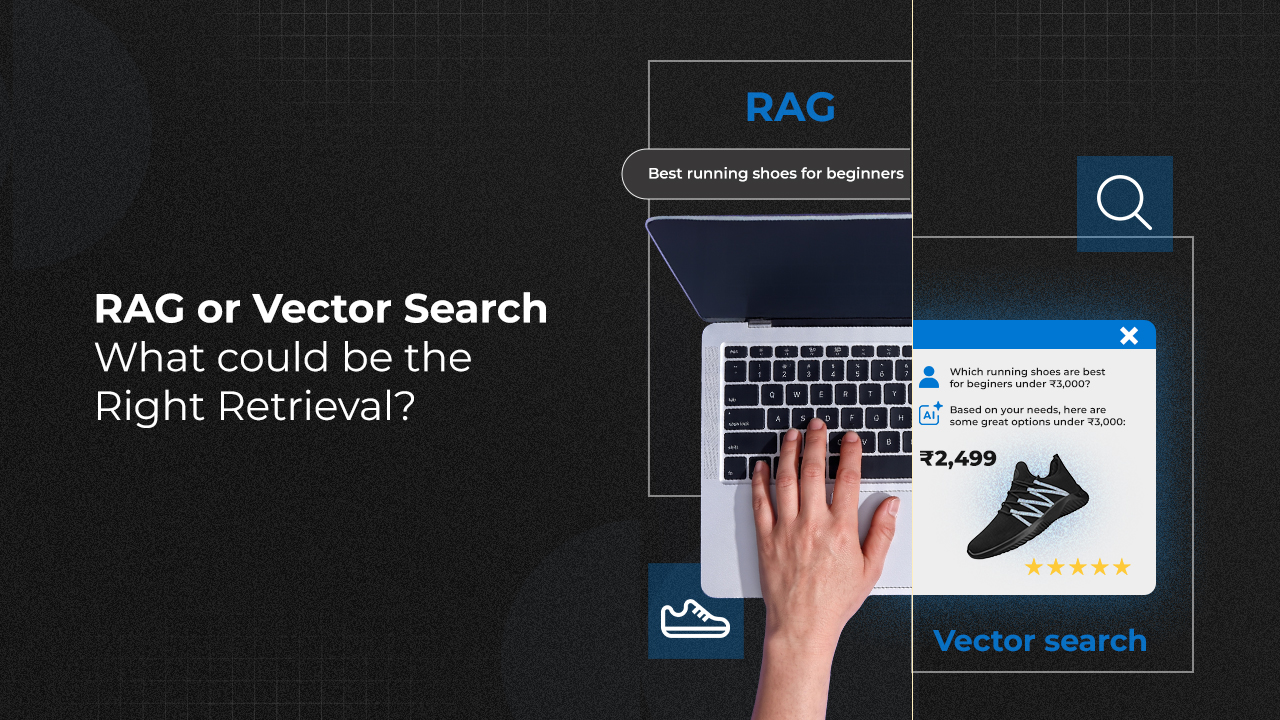
The ML engineering world welcomes new acronyms every few months. Previously, it was vector search, and today it is RAG (or Retrieval-Augmented Generation). However, since this is trending and businesses are often rushing to leverage RAG-powered features, the most important question is getting skipped: “Does your work actually need generation, or is retrieval enough?”
While both techniques are often discussed as an alternative to each other, they work at different levels of AI-retrieval implementations.
For businesses investing in e-commerce development services, understanding this distinction is essential because the retrieval layer needs to support the actual customer experience rather than add unnecessary complexity to the architecture.
- Vector search is a retrieval mechanism that searches for semantically similar information.
- RAG is an architecture that retrieves relevant information and provides that context to an LLM to generate a grounded response.
Understanding RAG vs vector search is critical because choosing the right architectural platform is paramount in getting your e-commerce platform running efficiently and effectively for a prolonged period of time.
Why Retrieval Architecture Matters for E-Commerce
Today, shoppers don’t just need search results or product titles according to their typed keywords. They want search engines to understand context, intent, personal preferences, and conversational questions.
The shift toward retrieval architecture matters presently because at the end of every search, product discovery is what matters most. Baymard’s 2026 research discovered that 56% of e-commerce sites don’t support users’ search requirements. Simultaneously, McKinsey recorded that 63% of European consumers use AI-powered tools to learn about products before making a move.
AI is rapidly changing how customers learn about and search for products, and that’s where retrieval architecture booms.
What Do You Understand By Vector Search?
Vector search is all about presenting information as numerical vectors with the help of an embedding model and keeping those vectors in a specialised index. It can also be referred to as semantic search or ANN (Approximate Nearest Neighbour) search.
For example, imagine you’re searching for a lightweight running jacket. A traditional keyword search here will look for matches for words used like “running”, “jacket”, or “rain”. But vector search will move beyond and dive deep into the semantic meaning of your query, finding items for you that are conceptually related and can be of great help.
That’s what vector search for e-commerce is for you.
What is RAG? How Does It Work?
If you’re after leveraging GenAI, RAG is your go-to choice.
Customer query → Retrieval → Relevant product information → LLM → Generated response
… This is exactly how Retrieval-Augmented Generation works.
For example, you’re searching for a beginner-level hiking shoe and are looking for the perfect combination of weight, grip, and price. So, to make your first-ever experience good, RAG retrieves relevant product specifications, records, and policies and transfers all of that to an LLM. The LLM then generates a natural-language answer grounded in that context.
RAG vs Vector Search: How Do They Differ?
Want to understand RAG vs vector search in the easiest way? Stop treating them as competing technologies and start considering them as layers of AI retrieval architecture.
Let’s make it even easier:
Vector search finds pieces of information that are most relevant to your search query.
RAG doesn’t just find relevant information but also uses an LLM to get a grounded response.
Is Hybrid Retrieval More Practical?
Yes, to a certain extent.
If the discussion of “vector search vs RAG” doesn’t focus on keyword search, it can automatically become misleading.
Suppose a shopper searches for “iPhone 16 Pro 128GB White”. In this scenario, semantic clarity is useful, but e-commerce businesses also need precise matching for the model, storage capacity, and colour.
Hybrid retrieval for e-commerce combines multiple retrieval methods, such as keyword matching, vector search, and structured filters. This allows the system to understand natural-language intent while still respecting exact attributes such as product names, SKUs, colors, sizes, storage capacities, and prices.
Note: Hybrid retrieval and RAG are not competing approaches. Hybrid retrieval determines how relevant information is retrieved, while RAG determines how that retrieved information can be supplied to an LLM for grounded generation.
A Quick Overview of RAG vs Vector Search
| Factor | Vector Search | RAG (Retrieval-Augmented Generation) |
|---|---|---|
| Primary purpose | Retrieves semantically similar information | Retrieves relevant information and generates grounded responses using large-language models |
| LLM required | No | Yes |
| Output | Ranked search results | Natural-language responses |
| Best suited for | Product discovery and semantic search | AI shopping assistants and conversational commerce |
| Latency | Generally lower | Usually higher because generation comes after retrieval |
| Architecture complexity | Often straightforward | More components and orchestration involved |
| Product recommendations | Yes | Yes, especially for conversational recommendations |
| Conversational answers | Limited | Strong fit |
| Grounded explanations | Not inherently | Core capability |
| Can use vector search? | Vector search is the retrieval mechanism | Yes, vector search is one component of the retrieval layer |
You must be wondering, if both vector search and RAG are treated as different layers of a retrieval architecture, why the distinction occurs.
The right answer to this is – “The addition of an LLM doesn’t automatically improve your search experience.”
- If customers are after buying products or services as quickly as possible, vector search is sufficient.
- If customers are looking for more, such as asking questions and receiving clear explanations, RAG is of greater help.
When Should You Use Which?
E-commerce businesses can choose vector search when discoverability is all that matters. It can be extremely useful for:
- Similar Product Discovery: A shopper can pick a product and get similar alternatives to choose from.
- Semantic Product Search: Customers don’t always search for products using the same terminology. In this scenario, vector search can bridge the gap and help them discover semantic results.
- Large Catalogues: Supposedly, your e-commerce business has millions of products on display. So, semantic retrieval here can help customers come across products related to their searches without knowing the exact terminology of the product.
- Recommendation Systems: Product embedding models can showcase products in a semantic space, allowing systems to find related items for customers.
McKinsey’s latest research uncovers that traditional search still dominates product discovery and can’t be replaced, regardless of whether AI-driven product discovery is rapidly moving forward or not.
On the other hand, our e-commerce business can prefer RAG if the customer is looking to get clarity through an answer.
A query like, “I need a gift for someone who is into hiking and has a budget of $100,” requires gathering information, explaining the customer’s intent, and bringing various pieces of information from multiple sources into one destination. That’s where RAG for e-commerce is paramount.
If you’re understanding RAG vs vector search, RAG differentiates by retrieving product policies, reviews, specifications, and other related information before transferring it all to an LLM and asking it to generate a value-driven response.
A Guide to Choosing the Right Retrieval Architecture for E-Commerce
Instead of looking for proofs of RAG or vector search being better today, focus on the actual customer experience.
Choose the vector search architecture when:
- Search speed needs to be majorly prioritised.
- You need meaningful product discoveries.
- Your application doesn’t encourage the need for conversational responses.
- Customers mostly browse products.
- You want a simple retrieval architecture in comparison with others.
Choose the Retrieval-Augmented Generation architecture when:
- Your e-commerce business is developing an AI shopping assistant for customers.
- Customers require comparisons or simple explanations.
- Your frequently changing product information needs to be retrieved and incorporated into conversational or explanatory responses.
- Pieces of information come from a variety of sources.
- You need grounded responses in your own product catalogue.
Choose Hybrid Retrieval when:
- Precise product qualities matter.
- You have the need for both semantic understanding and exact matching.
- Your customers use natural-language queries.
- Your catalogue includes both structured and unstructured pieces of information.
Final Thoughts
To conclude, the RAG vs vector search debate is never-ending. However, e-commerce businesses don’t have to treat these technologies as mutually exclusive ones. While vector search is a retrieval technique, RAG is an architecture that uses retrieval as an integral part of a larger generation pipeline.
If your platform needs both semantic retrieval and conversational generation, you don’t have to choose between them. Vector search can serve as one component of the retrieval layer within a broader RAG architecture.
The strongest retrieval architecture isn’t determined by which technology is generating the most attention. It’s actually determined by freshness requirements, query complexity, data characteristics, accuracy requirements, and customer experiences with the online store.
Frequently Asked Questions About RAG vs Vector Search
1. Is RAG similar to vector search?
No, they are different from each other. While vector search retrieves semantically similar information, RAG uses retrieval alongside an LLM to produce grounded responses.
2. Is RAG or vector search better for e-commerce?
There’s no universally correct answer to this because neither is better. Vector search is good for semantic search and product discovery, and RAG is good for conversational shopping assistants.
3. Is it possible to make vector search work without an LLM?
Yes, vector search doesn’t necessarily need an LLM to work. It operates independently and can retrieve and rank products based on semantic similarity.
4. Is RAG slower than vector search?
Yes. Since RAG’s process is lengthier than vector search, with the involvement of both retrieval and LLM generation, it takes more time to generate results.
5. How can vector search be used in e-commerce?
Vector search can be used for product discovery, similar-product recommendations, natural-language searches, and finding relevant products.
6. Can RAG reduce incorrect AI answers in e-commerce?
It can help by grounding responses in retrieved product information. However, answer quality still depends on the accuracy, freshness, and relevance of the retrieved data.
7. Can RAG work without vector search?
Yes. RAG does not require vector search specifically. Its retrieval layer can use keyword search, hybrid search, databases, APIs, knowledge graphs, or other retrieval methods.
8. Does RAG replace e-commerce search?
No. RAG does not inherently replace search. E-commerce platforms can use traditional keyword search, vector search, hybrid retrieval, structured filters and ranking alongside RAG depending on the customer experience.

 UI/UX Design
  Web Development
  Mobile App Development
  Internet Of Things
  Game Development
  Artificial Intelligence
  Digital Marketing
  Data Science Consulting