
 April 8, 2026
 Just when you thought you were getting the hang of SEO, it keeps moving ahead.
According to Search Engine Land, prompt research is the new layer in SEO (Search Engine Optimization) and GEO (Generative Engine Optimization).
This is why brands are already turning to AI SEO, where they will focus on making their content the source that AI cites within its answer.
Of course, the reason for this shift is obvious. AI search is quickly gaining momentum. Most people are now conducting searches within generative systems, and even the language they use is not the same as typical keywords.
Prompts are quickly becoming the default search queries, where users write long, conversational requests that are rich in context.
You may not have realized this, but buying decisions are being made within AI search engines.
So, if you want to learn how to make your content visible for conversational AI prompts, this guide will teach you the basics.
What is Prompt Research?

Prompt research is the new kind of research that analyzes typical prompts in AI systems in an effort to increase brand visibility in AI searches.
These days, a high percentage of searches are taking place inside generative systems like ChatGPT, Claude, and Perplexity as compared to search engines.
In fact, according to SEMrush, AI search traffic has grown by 527% compared to last year.
So, you can leverage popular user prompts to ensure that your content gets surfaced on the answers that the AI tools present.
Prompt research is the first step towards AI prompt optimization. The aim is to position your business or your product as an answer to typical prompts within that topic.
Unlike search engines, AI systems use semantic search to understand what people mean without necessarily needing exact keyword matching typed inside a prompt box.
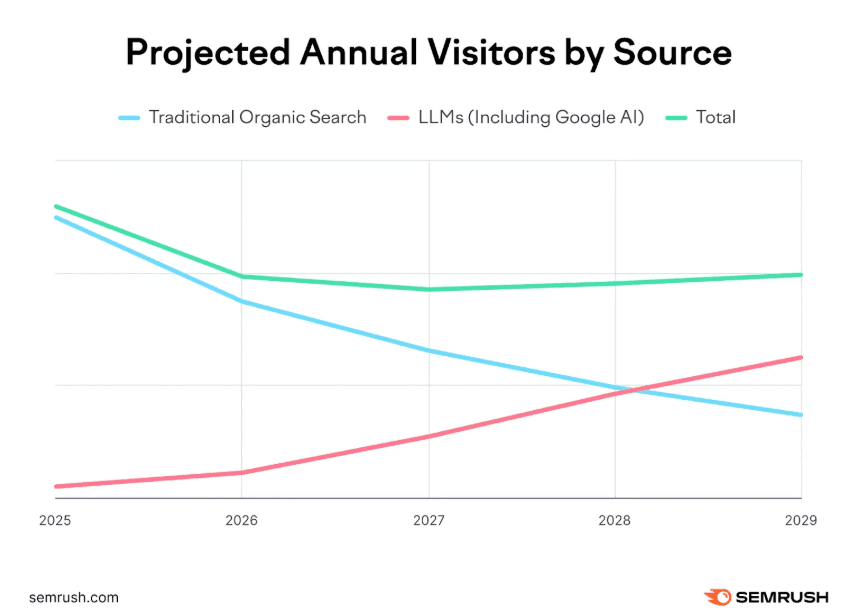
As you can see, AI search is projected to surpass traditional search in the coming years. So, whether you like it or not, your content strategy will have to evolve to AI search and discovery.
To clear any confusion, let’s see the difference between prompt research and keyword research.
Prompt research vs. Keyword research
These two approaches to search differ to a significant extent. How people write prompts on AI and how they use search engines are quite different.
Knowing this distinction will help you transition from traditional SEO to AI-driven visibility.
| Prompt Research | Prompt Research | |||
|---|---|---|---|---|
| The Goal | Understanding how people ask questions in AI tools | Understanding what people type into search engines | ||
| Platforms | AI tools like ChatGPT, Google Gemini | Search engines like Google Search, Bing | ||
| User intent | More conversational, detailed, context-heavy | Short, direct, often fragmented phrases | ||
| Example | “How do I fix slow checkout on my Shopify store?” | “fix slow Shopify checkout” | ||
| Output goal | Get AI to generate useful, accurate answers | Rank content higher in search results | ||
| Content style it supports | Natural, question-based, explanatory content | Structured content targeting specific terms | ||
| Tools used | AI chats, prompt testing, community forums | Tools like Ahrefs, SEMrush |
If you are just getting started with SEO, check out Search Engine Optimization (SEO): The Complete Guide.
Is Keyword Research dead in 2026?
No. Keyword research is still relevant in 2026.
Even though AI search is dominating, keyword research is still part of the process because these terms show us how people describe their problems and what they are trying to find.
You can reverse engineer keywords and search results, then work backward to turn them into natural, question-style prompts people would actually ask.
So suppose your keyword is “canvas shoes for men”, and the search results include product listings, style guides, and buying pages. This is how it can be turned into a prompt:
“Which canvas shoes for men are comfortable for daily use?”
The difference is that in prompt research, the keywords are not the final goal. You take them and turn them into natural, real questions people would actually ask.
What is really changing is what you optimize for.
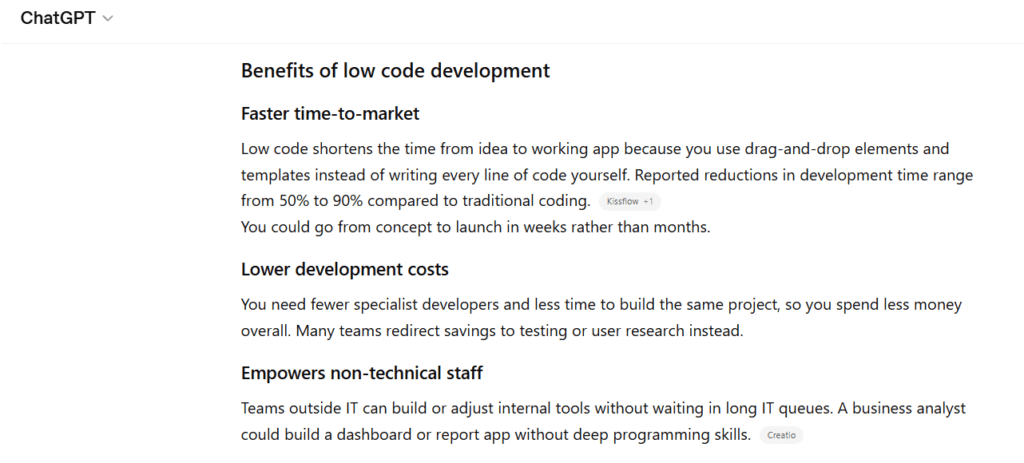
You are now optimizing content so that it becomes a cited source (just like in the image above) in answer to real, human-style AI prompts, not just short keywords.
Step to Conduct Prompt Research
1. Figure Out Exactly Who Is Asking
Before trying to figure out the right prompts, you must define the specific person using the AI.
In marketing, these are referred to as Personas.
You may have noticed that AI responds differently depending on how much detail you give.
If a searcher asks a broad question like “what is a good guitar?”, the AI just explains guitars.
Now, in case the searcher adds constraints (specific rules), the AI would need to compare brands and offer a recommendation. Your aim should be to find the prompts that force the AI to pick a winner.
What Makes a Person Change Their Question?
-
Their Skill Level: Someone who is a total beginner is likely to ask “how to play chords,” while a professional guitarist may prompt using phrases like “low-latency recording software.”
-
Their Main Problem: A good number of searchers are trying to avoid making a mistake. A parent might ask for “non-toxic paints for toddlers” because they worry about their child’s safety.
-
Their Budget: It’s also obvious that a person’s budget will influence the prompt. A searcher looking for a “budget-friendly espresso machine” is bound to get different results from AI than someone who has given a prompt like “the best professional-grade Italian coffee maker.”
2. Start With Your Normal Keyword Discovery
You can begin by using your go-to keyword research tools to find basic topics that people are interested in right now.
The aim is to find words that are popular but not too hard to compete for. You want to find words that fit every part of the sales funnel.
So, it needs to range from people just curious about a topic to people ready to enter their credit card details.
Once you have these short keywords, you will need to reverse-engineer them. This means turning a simple word like “hiking boots” into a full, natural sentence a human would actually type on ChatGPT or Perplexity.
How to Turn a Keyword Into a Prompt
-
Add a Reason: Rather than merely “running shoes,” use “running shoes for people with flat feet.”
-
Add Context: Elaborate on the keyword “travel tips,” with a natural question “is it safe to travel to Japan alone as a first-timer?”
-
Add Specifics: Use typical modifiers like “under $100,” “near me,” or “eco-friendly” to make the question more realistic.
3. Use an AI Research Tool to Check the Answers
At this point, you have a list of natural-sounding questions/prompts, and you need to see how the AI actually groups these topics.
You can use a prompt research tool to see if the AI understands your topic well enough to give advice.
Now, if you type the phrase “organic gardening for small balconies,” the tool might show you that the AI offers cluster topics related to the original topic with topics like “soil types,” “pot sizes,” and “specific seed brands.”
If you see that the AI is already grouping brands together, you can safely assume that it is a great question to track.
What to Look For
-
Topic Clusters: Check if the AI thinks your topic is related to other specific problems.
-
Brand Mentions: Notice if the AI is already suggesting your competitors when certain specific words/phrases are used.
-
Decision Power: If the prompt/question makes the AI list “Pros and Cons,” it is a very valuable question for your business.
4. Gather and Grow Your List of Questions
Now it is time to collect all these ideas into one consolidated list.
It’s best to move away from short, two-word phrases and focus on long, conversational questions. You can find these by looking at the data you already have.
Go into your website’s search data and look for questions that start with Who, What, Where, or How.
You can also go to a search engine and start typing your main topic to see what the “predictive text” suggests as a full question.
Action Steps to Find Questions
-
Filter Your Data: Using tools like GSC (Google Search Console) go through your past website visitors’ questions to find the ones that sound like a conversation.
-
Use Search Suggestions: Type your product/service name into a search engine and see what the “people also ask” section says.
-
Create a smart blend: See that you have a good mix of both “informational” questions (people wanting to learn) and “transactional” questions (people wanting to buy).
5. Organize Your Prompt Library
The last step is to build a library where you keep all these questions you have compiled in a cohesively categorized manner.
You should not just list them randomly. Group them by intent (what the user wants) and by where they are in their journey.
With a prompt library, you get to see the big picture. Sure, the tendency will be to just pick the questions that get the most traffic. This would not be advisable.
Instead, pick the questions that are most valuable to your company, the ones that will most likely lead to searchers choosing your products or services.
How to Sort Your Prompt Library
-
Top of Funnel (Learning phase): These would include questions where people are just starting to learn about the subject matter, like “why is skin hydration important?”
-
Middle of Funnel (Comparing phase): Group questions where people are looking at different ways to solve a problem.
-
Bottom of Funnel (Buying phase): List the high-value questions where the AI is forced to recommend a specific product to a buyer.
-
Assign Value: Give each question a priority score. This way, you will know which prompts to focus on first when you are creating new content.
Summing Up
If you expect to show up on generative AI platforms, you have no choice but to align your content to typical prompts that people ask.
The quicker you start researching prompt patterns related to your business, the better your chances of appearing in AI-generated answers.
If you need help getting started with prompt research for your brand, the experienced team at Webskitters can help. We use the latest prompt research tools and proven techniques to boost your AI visibility.
Get in touch with our SEO experts to revamp your SEO strategy.
Frequently Asked Questions
1. What is prompt research?
Prompt research is the process of understanding how people ask questions in AI tools. You study real phrasing, intent, and constraints to create content that AI systems can use.
2. How to do prompt research?
To conduct prompt research, you need to:
-
Define your target persona clearly
-
Map problems to product solutions
-
Study real user search language
-
Turn keywords into question prompts
-
Test prompts in AI tools
3. What is the difference between prompt research and keyword research?
Keyword research focuses on search terms people type into search engines. Prompt research focuses on full questions people ask AI, including context, intent, and constraints that influence recommendations and answers.
4. How can prompt research help my business gain online visibility?
Prompt research helps you align content with how people ask AI questions. This increases your chances of being included in AI-generated answers and recommendations across platforms.

 UI/UX Design
  Web Development
  Mobile App Development
  Internet Of Things
  Game Development
  Artificial Intelligence
  Digital Marketing
  Data Science Consulting