May 7, 2026
 For almost thirty years, enterprise websites acted like digital brochures, serving mainly as static sources of information.
That time is over.
In 2026, thanks to new agentic web design workflows, today’s enterprise sites work as independent, intelligent systems.
Instead of just automating simple tasks, these sites use multi-agent orchestration and reflect-refine loops to both share information and handle complex business tasks on their own.
This guide explains why leading brands are moving away from static code and choosing agentic architectures to stay ahead and improve their return on investment.
From Passive UI to Agentic Systems
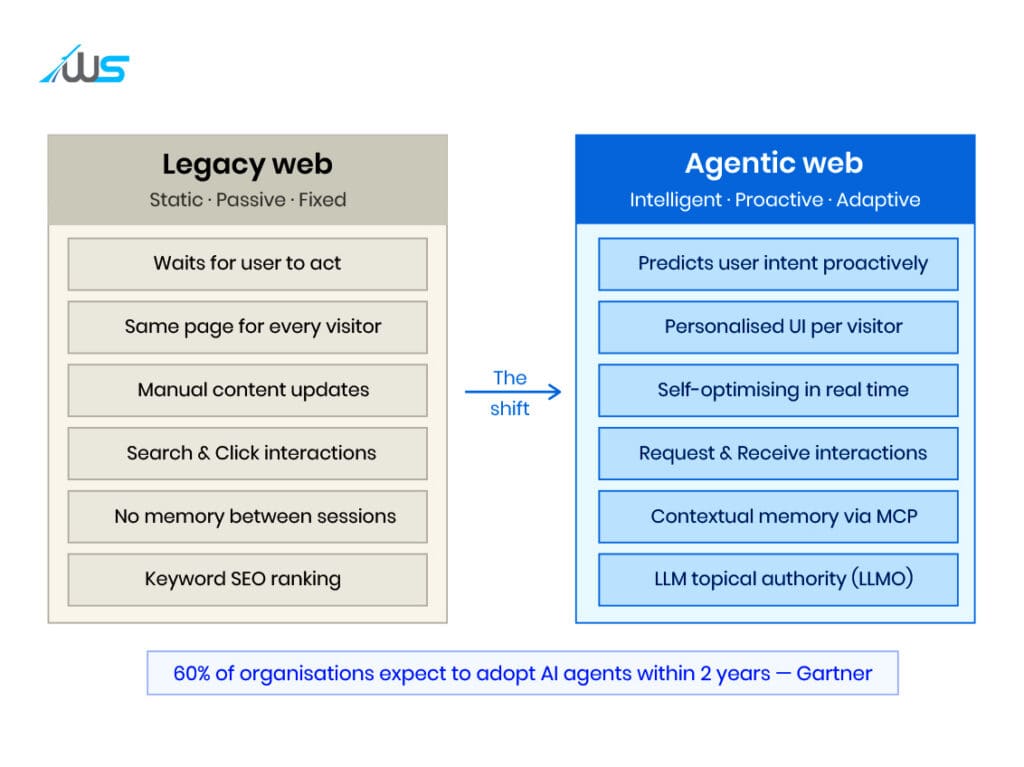
A Gartner CIO and Technology Executive survey found that while only 17% of organizations use AI agents today, more than 60% expect to adopt them within the next two years.
We can see this shift already in the way digital products and websites are expected to function.
Older or legacy web design tends to be passive. Traditional websites wait for users to act, but agentic sites predict what users need and respond proactively.
How User Interaction Is Evolving
We have shifted from the days of “Search and Click” to a new era of “Request and Receive.”
More leaders are choosing Agentic UI Design because it meets today’s demand for smooth, effortless experiences.
By adding autonomous interfaces and generative UI elements, companies can offer a “Machine Experience (MX)” that adjusts instantly in real time.
Beyond Aesthetics: The Cognitive Load Factor
This goes beyond aesthetics — it is about cognitive load, a factor that is frequently overlooked. The goal is to reduce friction and make things genuinely easier for users.
Static sites make users search for answers, while agentic sites leverage user intent mapping to proactively deliver the solutions they need.
This creates self-optimizing funnels that turn visitors into customers automatically, which helps the business grow.
The Technical Stack: Multi-Agent Orchestration
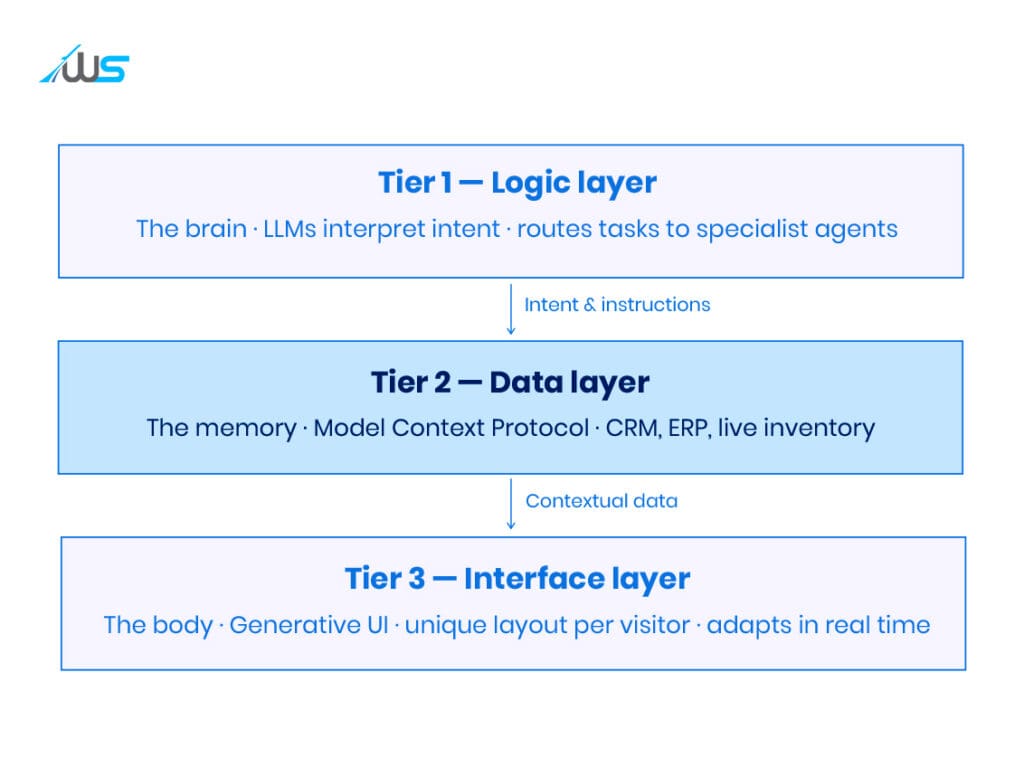
To understand the “Agentic Web,” one must understand the architecture. Instead of a single codebase, it now uses a three-tier Agentic Stack.
Tier 1: The Logic Layer (The Brain)
This layer uses Large Language Models (LLMs) for more than just text. When someone visits a site, the Logic Layer figures out what they want to do and breaks the task into smaller parts for specialized agents.
Tier 2: The Data Layer (The Memory)
With the Model Context Protocol (MCP), agents connect to your company’s internal data like CRMs, ERPs, and live inventory. This helps the website give accurate, real-time answers instead of general AI responses.
Tier 3: The Interface Layer (The Body)
This is the Generative UI. Rather than showing everyone the same homepage, the site displays buttons, forms, and galleries that match what each user wants to do.
Building Scalable Systems with Hybrid Engineering
Seeing as AI is now becoming part of everyday enterprise development, CTOs are right to worry about “AI-generated technical debt.”
Of course, the risk is not that AI will write bad code every time.
The real risk is that AI can produce code that looks functional on the surface but becomes difficult to maintain, test, or scale once the product grows.
This is where Hybrid Web Development gives enterprises a safer way forward.
The Architect vs. The Automaton
The reason why hybrid engineering works is that it does not treat AI as a replacement for architectural judgment.
AI’s role is primarily to speed up repetitive development tasks, automate the generation of boilerplate code, and allow quicker feedback on iterations.
Nonetheless, all decisions on how the system is to be built (e.g., how to manage dependencies and what the growth of the product will look like) will always be made by a human architect.
You can work with experienced AI consultants to help map scalability and long-term AI integration much earlier in the architectural process.
Using AI-assisted coding alongside legacy modernization, older systems can be rebuilt into modular, cleaner frameworks based on Next.js. That gives enterprises the speed they want, not to mention the technical discipline they need before moving business-critical experiences into production.
What Happens When AI-Built Code Has to Scale?
Critically, speed and engineering quality do not have to work against each other.
A properly built hybrid system can handle heavy traffic while keeping the CI/CD pipeline stable, visible, and easier to manage.
Performance metrics are important for any enterprise; however, they are not merely a technical benchmark. Performance also affects customer trust, conversion rates, operational costs within the enterprise, and team-wide confidence.
Therefore, hybrid engineering provides faster enablement without creating low-quality, hard-to-maintain code or accessibility issues.
Governance and Security
AI usage in websites, processes, and customer-facing systems is only going to accelerate. But the security you offer is what will differentiate your business from the rest.
You can’t grant an autonomous agent access to business data, customer behaviors, or internal operations or processes without having a strong Enterprise Auditing Framework.
Managing the AIBOM
To ensure appropriate use of AI-generated content, companies need to have clear visibility into the outputs of artificial intelligence processes.
Teams need to know precisely what was generated, where it sits inside the product, what data it touches, and whether or not it introduces any security or compliance risks.
To secure AI-Generated Code, enterprises need more than basic vulnerability scans.
A secure software development life cycle (SDLC) must check for LLM hallucinations, prompt injection, weak dependencies, authorization issues, and undocumented logic.
A detailed AIBOM (AI Bill of Materials) gives technical leaders a clearer view of every AI-assisted component, in particular, how it was created, reviewed, tested, and approved.
The Zero-Trust Approach
Firstly, what is the Zero-Trust approach?
Simply put, it means your website can be built with the speed of tools like Claude or Gemini while still following the security discipline expected from a global financial institution.
For this, a Zero-Trust architecture is required in which every AI-generated component is validated against predetermined security procedures.
Accordingly, no output is trusted simply because it works. It must be checked, documented, and tested before it becomes part of the live product.
Hyper-Personalization through Intent-Driven Design
You, like most consumers today, expect a website to quickly understand what you need.
You would not want to dig through generic pages, repeat the same information, or follow a fixed path that does not match your intent.
This is where intent-driven design becomes valuable.
By using a customized customer journey and predicting how users navigate an enterprise website, retailers can create distinct messages to present to different stakeholders.
For example, a CFO might view different data points, an engineering manager would only see relevant technical documentation, and a high-intent buyer will see faster booking/fulfillment options.
Moving Past Heatmaps
If you study how users behave on modern websites, you will realize they rarely follow one neat journey.
A user may compare pages, pause, return later, search again, and expect the experience to keep up.
Now, traditional heatmaps can show where users click, but they do not always explain what users are trying to achieve.
This is why enterprises are moving toward behavioral UX. When a system can reason through task decomposition, it can adjust a landing page in real time to solve a user’s specific problem.
Instead of showing every visitor the same static message, the experience becomes more relevant, more useful, and more likely to convert.
Compliance and Accessibility
WebAIM 2026 report reviewed 1 million website homepages. On average, each homepage had 56 accessibility problems, showing how many websites violate WCAG guidelines.
The fact is that digital accessibility is no longer something enterprises can leave until the end of a project. It is now a legal, ethical, and commercial requirement.
In order to comply with 2026 website accessibility standards, a website must be constructed with an inclusive design approach from the very start. Trying to implement accessibility after the product launch just results in patchwork, which it is best to avoid.
The Cost of Non-Compliance
You may not have realized this, but automated legal audits are becoming more and more common. And, any accessibility gaps in your website or app can create serious business risk.
Accessibility gaps exist when a website is missing any of the following:
- proper label identification
- contrast ratio(s) between text and background(s)
- user-friendly navigation structure
- accessible forms of interaction
By using AI-assisted compliance workflows, you can ensure your site meets WCAG 2.2 Level AA and GIGW 3.0 requirements from the first line of code. This reduces rework, protects the brand, and gives internal teams more confidence before launch.
Assistive Technology Integration
The more accessible your website is, the wider its reach will be. It is possible if your site is built with assistive technology and semantic HTML in mind.
This will ensure that screen readers, voice tools, keyboard navigation, and search engines can fully understand your website.
Additionally, creating accessible design is bound to provide a better user experience for all users, since it reduces friction between users and the website.
There is a good reason why web developers take time to develop a well-structured website, with clearly labeled content, good contrast ratios, and easy-to-use navigation. The aim is to allow all users to navigate through the website with fewer problems.
Invisible SEO and AI Discovery
The way users find brands has changed. Ranking high on Google Search is great.
But, you should know that a large number of searchers are discovering companies through AI agents such as Perplexity and Gemini.
This shift makes invisible SEO a serious part of enterprise visibility. Basically, it means optimizing for search engines without making the optimization efforts obvious to the human reader.
Optimizing for the LLM
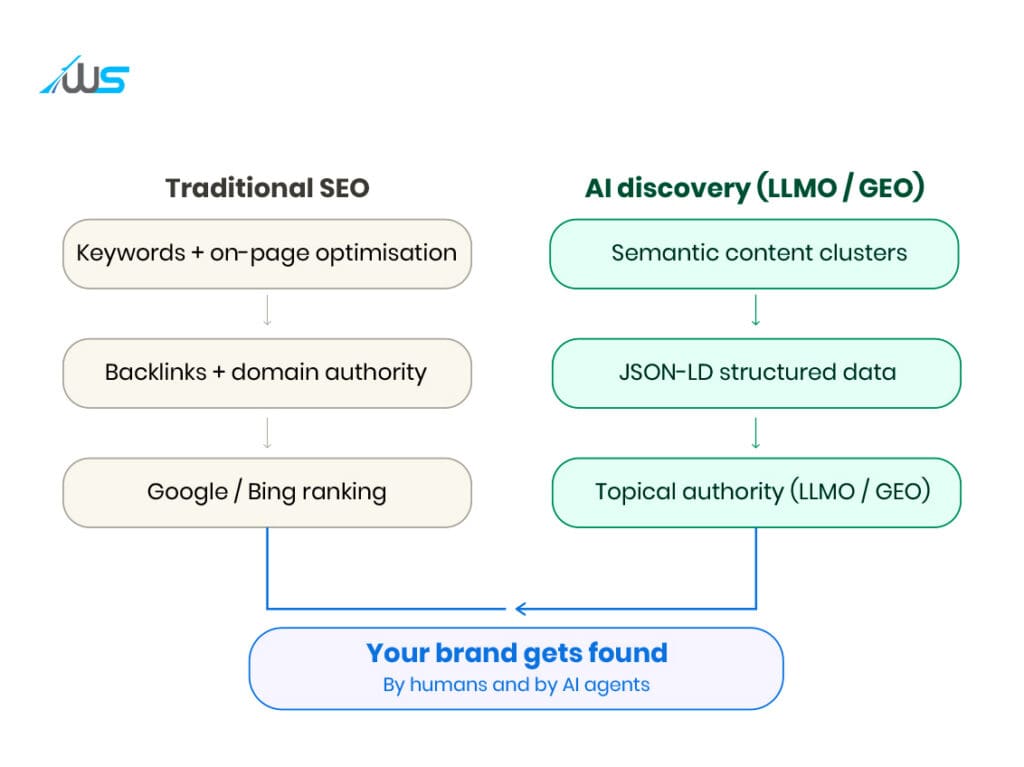
In fact, AI discovery depends on how clearly machines can understand your expertise.
Strategies, including LLM Optimization (LLMO) and Generative Engine Optimization (GEO), can help strengthen your brand’s topical authority.
AI platforms then detect that your brand knows a lot about a particular topic, making it more likely that your business will be mentioned or surfaced in AI-generated answers.
Of course, your web content cannot simply target keywords anymore. It needs to clearly show what your business knows, how topics connect, and provide genuinely useful information that AI systems can easily understand and trust.
Semantic Authority
Using JSON-LD structured data and semantic clusters can make your expertise easier to see, connect, and recommend.
Currently, SEO is not only about getting a page to rank. It is about becoming the answer that AI systems trust enough to pass on to a human user.
Speed-to-Market: Accelerated Prototyping
As any CXO will tell you, time is often the most expensive resource. You may have a strong product idea.
But the value of that idea diminishes as it goes through months of waiting for manager approvals and multiple rounds of design iteration.
By implementing an Accelerated Prototyping process, it is possible to have a project evolve from Proof of Concept (PoC) to functional MVP in 48 hours.
Eliminating the Feedback Loop
Using wireframe-to-code agentic workflows significantly reduces the delays that slow down digital projects. Teams can test a working interface earlier, get quick feedback from stakeholders, and identify weak points before the development even begins.
This agile design sprint model allows for early user-testing through the iterative design-sprint model.
Instead of having decision makers debate about abstract mockups for weeks, they have the opportunity to interact with a working prototype, allowing them to make more informed decisions based on real-user behavior.
The CXO Decision Matrix: In-House vs. Agency Partner
Many enterprises struggle with the “Make vs. Buy” decision regarding AI web infrastructure. What you need to check is not just who can build it, but who can build it faster, safer, and with the right governance from day one.
| In-House AI Team | Managed Agency Partner | |
|---|---|---|
| Speed to Market | 6–12 Months (Hiring & R&D) | 4–8 Weeks (Ready-to-use Workflows) |
| Security Risk | High (Internal Trial & Error) | Low (Vetted SDLC & AIBOM Frameworks) |
| Cost Control | High Fixed Salaries/CapEx | Scalable OpEx based on Project Scope |
| Expertise | Narrow Focus | Broad (16+ years across multiple industries) |
| Technology | Tool-dependent | Tool-agnostic (Claude, Gemini, GPT-5 integration) |
The 6-Month Roadmap from Static Website to Agentic Experience
The move from a static website to an agentic digital experience needs to be done in stages. The best way to go about this is to build the foundation first, then introduce automation, personalization, governance, and orchestration in controlled stages.
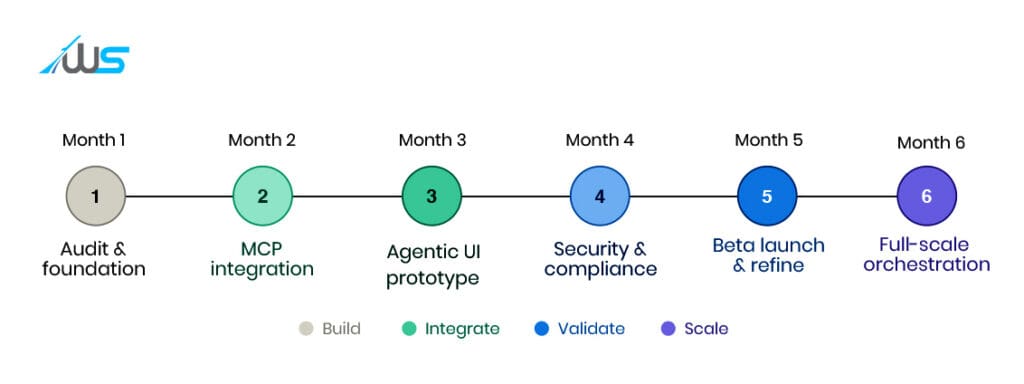
1. Month 1: Audit & Foundation: An audit is conducted of your current tech stack, user journeys, analytics setup, accessibility gaps, content structure, and performance issues. The goal is to identify where agentic integration can create the fastest and safest business impact.
2. Month 2: The MCP Integration: Model Context Protocol gets implemented to securely connect enterprise data with AI agents. This gives the system the context it needs without exposing sensitive information unnecessarily.
3. Month 3: Prototyping Agentic UI: The team then develops the first generative UI components and tests them with controlled user scenarios. At this stage, the focus is not only on design but also on how intelligently the interface responds to intent.
4. Month 4: Security & Compliance Pass: After the AIBOM audit is run, it’s best to conduct Accessibility 2026 checks as well, to make sure the system is secure, compliant, and ready for wider testing.
5. Month 5: Beta Launch & Reflect-Refine Loops: The product is then tested on a selected audience segment to study real-world usage. The insights gleaned help to refine agent behavior, content logic, conversion paths, and performance.
6. Month 6: Full-Scale Orchestration: It is only after testing is complete that the experience gets rolled out at scale with automated Invisible SEO monitoring, performance checks, governance controls, and continuous optimization.
ROI and the Price of Inaction
All things considered, the gap between “Digital Leaders” and “Digital Laggards” in 2026 will come down to how quickly companies can adapt.
While static websites will still exist, they unfortunately will struggle to compete with digital experiences that can personalize, reason, test, and optimize in real time.
ROI of Agentic Architectures
Maintenance: Enterprises can reduce developer overhead for updates by 40–50%, because recurring changes, content adjustments, and interface refinements can be handled faster with the right governance model.
Conversion: Agentic funnels can create a 22% average lift in lead generation by responding to user intent instead of pushing every visitor through the same fixed journey.
Search Share: Companies that do not optimize for invisible SEO are likely to lose visibility. The reason for this is that current users are relying more heavily on AI-based search and recommendation engines. Although this may be true at different speeds across industries, the direction is already clear.
Industry Deep-Dives
Different industries will use agentic websites in different ways. The value is not simply that the site becomes “AI-powered.” The value comes from solving specific customer problems faster, with less friction and more relevance.
-
B2B SaaS: Agentic UI can onboard users based on role, company size, use case, and product maturity. It can also generate custom demo environments on the fly, helping sales teams shorten the path from interest to product understanding.
-
Luxury E-commerce: Agents can act as digital personal shoppers, recalling preferences across devices and steering users toward products that match their style, budget, occasion, and browsing history.
-
Healthcare: Adaptive interfaces can adjust content based on health literacy levels, helping patients understand services, symptoms, next steps, and care options with greater clarity.
Why the Human-in-the-Loop Agency Still Wins
So far, agentic web design workflows have been successful, but we cannot attribute that success solely to the tool stack.
It is the judgment behind how those tools are selected, governed, integrated, and improved over time.
If you are looking for experienced developers to build high-performing agentic websites, you have come to the right place.
At Webskitters, we create intelligent digital experiences that understand user intent, guide visitors better, and support real business growth.
With the right balance of AI and human expertise, our AI development team can build a website that is not just ready for 2026 but ready for what your business needs next.
Talk to our experts about your project.

 UI/UX Design
  Web Development
  Mobile App Development
  Internet Of Things
  Game Development
  Artificial Intelligence
  Digital Marketing
  Data Science Consulting