
 March 10, 2026
 “Companies don’t become AI-native by hiring data scientists. They do it by building AI-fluent leadership,” said Laura Stevens, the MD of Data and AI at Board of Innovation. That’s how crucial AI fluency is for business right now. And without AI fluency, you cannot carry out a smooth, seamless AI integration.
But, how important is AI fluency for businesses?
AI fluency is a core leadership capability that enables businesses to understand, question, and strategically leverage AI without needing technical expertise. Without AI fluency, initiatives become fragmented and hype-driven; with it, organizations gain alignment, smarter investments, and a lasting competitive advantage.
Do you want to learn more about this? Let’s go!
AI Fluency: Nice-to-have or a Show Stopper?
It is no secret that AI has long since stopped being a scattered initiative or side project. It has been the core of how organizations compete, scale, and operate. Business owners are aware of this, but they are still navigating the AI space blindly.
So, the ambition to be AI-ready is there. But AI fluency still sits at the top of the list of reasons why businesses’ AI ambitions don’t translate into real results. Without this fluency, efforts stall, fragment, and resources are wasted.
And what’s worse is if your competitors become AI-fluent before you do.
The time’s gone when AI fluency was a nice-to-have for businesses. It is now a core leadership currency for your business.
What is AI Fluency?
AI fluency is the capability to question, understand, and lead in the field of Artificial Intelligence. It is not at all about coding.
AI fluency is about understanding the benefits and limitations of AI for businesses, enabling them to lead with confidence and without hesitation.
You can think of AI fluency as financial fluency. You could have no knowledge of accounting, but can be financially fluent to make financial decisions. That means you don’t need to understand everything about numbers. All you need is sufficient financial awareness and knowledge to lead your business.
Similarly, you don’t need to be a data scientist to be AI-fluent and steer your business toward effective growth by leveraging AI.
An AI-fluent workforce can:
- Differentiate between hype and reality
- Understand the practical capabilities of AI and avoid inflated promises
- Spot the areas where AI can drive real value
- Ask sharper questions and improve
- Build effective alignment across departments and functions
- Make insightful decisions that scale with time
- Identify value-driven and high-impact opportunities
- Set expectations for the role of AI in business transformation
When your team is AI fluent, you can shape AI integration and set a benchmark for your industry. And, if you want your team to focus on other operational aspects, AI integration services is the way to go.
Why AI Fluency Matter for Businesses?
When we talk about AI fluency for businesses, we need to discuss how well people are using AI today. Recently, Anthropic published a study regarding AI usage patterns. And, the findings show substantial positive results:
- Iteration and Refinement: Most AI users iterate and refine the output. Almost 85.7% of users iterated and refined their first response. So, users aren’t using AI as vending machines but are treating AI as a tool to refine their results, showing effective human-machine collaboration.
- The Artifact Effect: Around 12% of the conversations led to the production of AI artifacts. Artifacts are AI-produced assets like documents, codes, apps, or interactive tools. It was observed that around 14.7% users clarified their goals before settling for the result.
These two findings show that users are becoming increasingly AI-fluent. That’s what you need for your business, too. Let’s explore why AI fluency matters for your business.
In simple terms, a lack of AI fluency in the workforce can cause projects to get stuck at the pilot stage. In the process, valuable resources are wasted, and departments start chasing shiny things rather than valuable assets. In all these, the business loses opportunities.
Negative Effects Seen Due to the Lack of AI Fluency
- Businesses start believing the hype rather than evaluating AI’s real impact and capabilities. This leads to flashy tools and fancy demos that deliver no real ROI.
- The initiatives are starting to fragment rather than being properly aligned. Departments within a business start going in different directions with a lack of a long-term strategy. This limits the business’s growth.
- Lack of AI fluency also leads to reactive decision-making rather than a strategic one. Businesses start taking AI as a side project until their competitors start using it. This restricts businesses from setting the industry’s pace.
On the other hand, AI-fluent businesses start embedding AI rather than just integrating it into processes. We will now discuss the 4 major benefits that your business can have with an AI-fluent workforce.
The Benefits of AI Fluency for Businesses
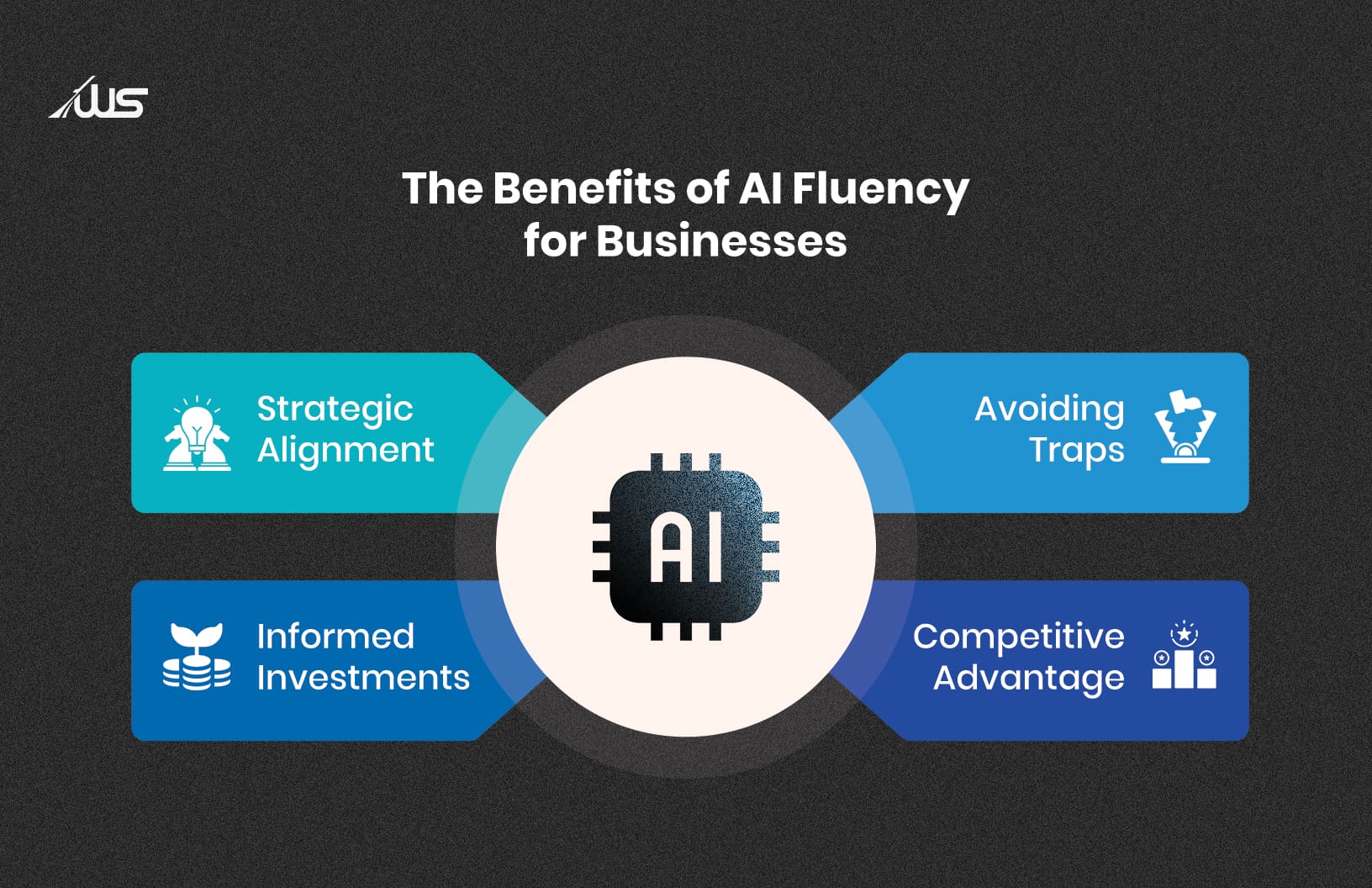
Strategic Alignment
As leadership and the workforce begin to understand AI’s capabilities, strategic errors and misjudgments decrease. The usage of AI agents in businesses is transforming them. According to McKinsey’s State of AI 2025 report, 62% of businesses said that they are experimenting with Agentic AI. If your business becomes AI fluent, the fragmented initiatives become aligned and coordinated. All these lead to impactful outcomes for your business.
Informed Investments
AI fluency allows the leadership and the workforce to ask important questions. The projects start getting vetted based on outcomes instead of hype to do “something that involves AI.” Plus, it saves valuable resources that don’t align with the goals, allowing investments to be more effective.
Avoiding Traps
Without a clear comprehension of AI, businesses can easily fall into various traps. Overestimating AI capabilities and setting absurd expectations are among the most important, if not all, of these common pitfalls. An AI-fluent business can navigate these challenges and integrate AI slowly (in stages), making sure the transition is smooth and seamless.
Competitive Advantage
Today, every industry is highly competitive. And, AI is one of the strongest factors that help businesses thrive and scale. So, AI fluency can help you outpace your competitors. AI-fluent businesses can identify opportunities more effectively and respond pragmatically to industry changes without a reactive approach.
AI isn’t your Enemy. The Absence of AI Fluency Might Be!
AI initiatives and AI integrations don’t stall because of your tech. It stalls because the workforce isn’t AI-fluent. If they aren’t fluent, they cannot stay aligned and integrate AI. And, they won’t be able to lead.
AI fluency is essential for both the workforce and the leadership team of a business. It allows executives and leaders to stand out, invest wisely, and lead with efficiency.
Do you want to integrate AI in your business processes but don’t know how to do it smoothly? We are here for you.
Book a call with our AI experts at Webskitters and carry out hassle-free AI integration.
FAQs on AI Fluency
1. What is AI fluency?
AI fluency is the ability to understand, question, and strategically use AI without coding.
2. Do leaders need technical knowledge to be AI fluent?
No, AI fluency is about understanding impact and limitations, not technical development.
3. Why is AI fluency important for businesses?
It helps organizations make smarter decisions and avoid hype-driven investments.
4. What happens without AI fluency?
Projects stall, resources get wasted, and opportunities are missed.
5. How does AI fluency create a competitive advantage?
It enables businesses to identify real opportunities and act strategically ahead of competitors.

 UI/UX Design
  Web Development
  Mobile App Development
  Internet Of Things
  Game Development
  Artificial Intelligence
  Digital Marketing
  Data Science Consulting