 July 13, 2026
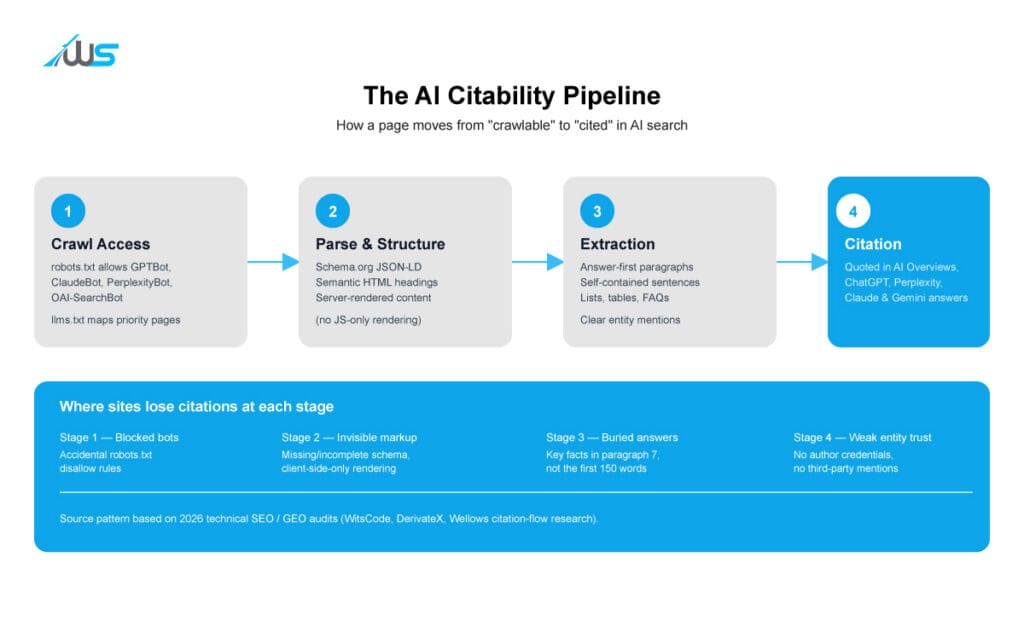
 A growing share of your buyers are meeting your brand for the first time inside an AI answer, not a list of blue links. ChatGPT, Google AI Overviews, Perplexity, and Claude don’t rank your page — they read it, decide whether to trust it, and either quote it or skip it entirely. That decision happens in milliseconds, based on signals most traditional SEO checklists never mention: whether your robots.txt lets AI crawlers in, whether your schema markup identifies who wrote your content, and whether your key facts sit in the first 150 words instead of buried in paragraph seven.
This guide is a practical, technical checklist for making your website citable — not just crawlable — by the AI systems that are quietly becoming a primary discovery channel in 2026.
What “AI-Citable” Actually Means (And Why It’s Different From “Rankable”)
“Rankable” means a search engine can index your page and place it on a results page. “AI-citable” means a generative model can access, parse, trust, and lift a clean, self-contained piece of your content into its own answer — with your brand attached as the source.
The two overlap heavily, but they’re not identical. A page can rank on page one of Google and still be invisible to AI Overviews if:
- Its key facts are wrapped in vague, unquotable prose instead of direct statements
- It has no structured data telling machines what the content is (an article? a product? a step-by-step guide?)
- Its robots.txt accidentally blocks the crawlers that feed AI answer engines
- It has no clear, verifiable author or organization behind the claims
In short: traditional SEO gets you discovered. AI citability gets you quoted. Both now run through the same technical foundation, which is why this has become a checklist item for every technical SEO audit in 2026 — and why it connects directly to a broader topical authority content strategy, rather than being a bolt-on tactic.
Why This Belongs on Your Technical SEO Checklist Now
Three shifts explain the urgency:
- AI crawlers now make up a massive share of web traffic. Automated bot requests have overtaken human visits on large parts of the web, and a meaningful share of that traffic is AI systems deciding how — or whether — to represent your site in an answer.
- Search and training bots are different, and treating them the same costs you citations. Search/retrieval bots (like OAI-SearchBot, ClaudeBot’s search variant, and PerplexityBot) fetch pages in real time to answer a live query. Training bots (like GPTBot and Google-Extended) collect data to train future models. Blocking the wrong one silently removes you from AI answers; blocking the other is a legitimate content-licensing decision.
- Citation is winner-take-few, not winner-take-all. Unlike a search results page with ten slots, an AI answer might cite three or four sources for an entire topic. If your page is technically inaccessible or structurally unquotable, you don’t rank lower — you disappear from the answer completely.
Foundation Layer: Crawler Access, robots.txt & llms.txt
Before content quality or schema matters at all, an AI system has to be allowed in. This is the layer most sites get wrong without realizing it.
Audit robots.txt for AI Crawler Access
Check your robots.txt for accidental or outdated Disallow rules affecting:
- GPTBot and OAI-SearchBot (OpenAI)
- ClaudeBot and Anthropic’s search-agent user agent
- PerplexityBot
- Google-Extended (Google’s AI training crawler, separate from Googlebot)
- Applebot-Extended
Make a deliberate choice, not a default one. Review OpenAI’s GPTBot documentation and the Robots Exclusion Protocol standard alongside your own robots.txt best practices so the file allows retrieval/search bots unconditionally (so you can still be cited in real-time answers) while making a separate, documented call on training bots based on your content-licensing preferences.
Add an llms.txt File
llms.txt is a proposed, increasingly adopted standard: a plain Markdown file at your domain root that gives AI models a clean, curated map of your most important pages, without forcing them to parse full HTML. See our guide on how to write an llms.txt file for the full syntax. A minimal version includes:
- An H1 with your brand name
- A one-line blockquote summarizing what you do (this becomes your model-facing identity statement)
- H2 sections linking to your highest-value pages (docs, pricing, cornerstone guides)
It doesn’t guarantee a citation, but it removes friction for the systems deciding whether to trust and reuse your content.
Fix Server-Side Rendering Gaps
Many AI crawlers execute little or no JavaScript. If your key facts only appear after client-side rendering, test your page with JavaScript disabled — if the answer disappears, so does your citation eligibility. Server-side rendering or static generation for content-critical pages is no longer optional.
Structured Data: The Schema Types AI Systems Trust Most
Schema markup is no longer a rich-snippet nice-to-have — it’s how a machine confirms what your content is, independent of how it reads. See our complete schema markup guide for SEO for full implementation detail. In 2026, incomplete schema is treated by many AI-first technical audits as a foundational gap, on the same tier as crawlability.
Priority Schema Types
- Organization schema with sameAs links to your verified social and knowledge-graph profiles — establishes brand entity trust
- Article schema with headline, author, datePublished, and dateModified — confirms topic ownership and freshness
- FAQ Page schema — the most directly extractable format for AI answer engines; each Q&A pair is a ready-made citation unit
- Person schema for every named author or contributor, linking to a bio page and external profiles — this is the structural half of E-E-A-T
- How To schema for step-by-step content
- Breadcrumb List schema to reinforce your topical hierarchy
Why date Modified Matters More Than You’d Think
AI systems weigh recency heavily when selecting a source to cite. A page with a current, accurate dateModified field — paired with a visible “last reviewed” date on the page itself — reads as a more citable object than an otherwise-identical page with no freshness signal.
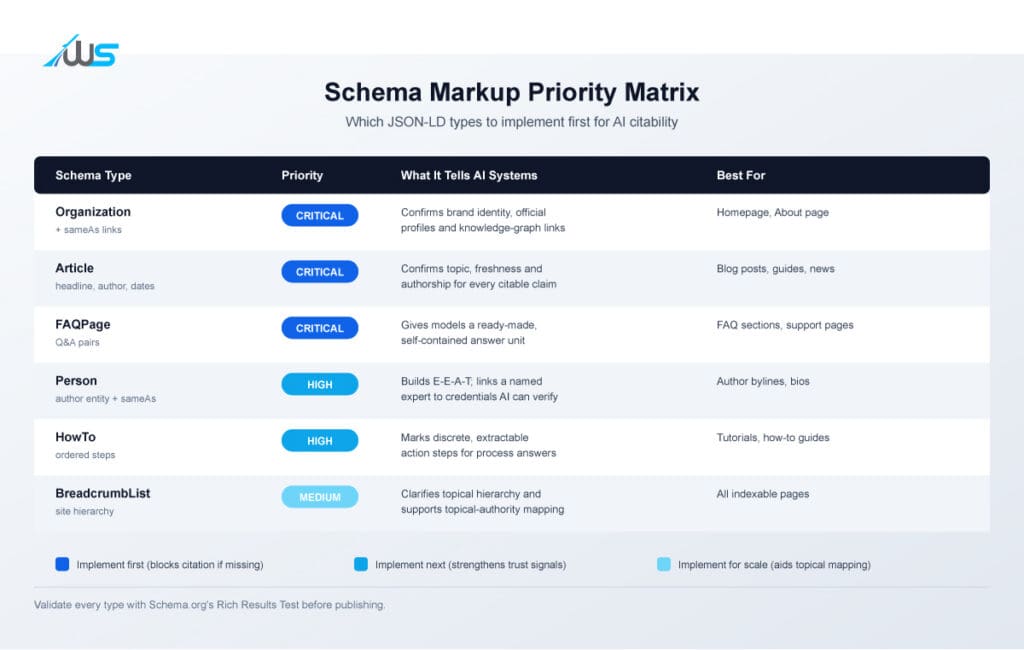
Always validate implementations with Google’s Rich Results Test and cross-check syntax against the official Schema.org vocabulary, following Google’s structured data guidelines before publishing.
Structuring Content So It Survives the Extraction Cut
Getting crawled is the easy part. Getting extracted is where most technically sound pages still fail.
Lead With the Answer
Put the direct, plain-language answer to the page’s core question in the first 150–200 words. Models tend to weight and quote heavily from the opening portion of a page, so if your best-supported claim is in paragraph seven, it may never be seen.
Write Extractable, Self-Contained Sentences
Each key claim should make sense pulled completely out of context — because that’s exactly what happens when it’s quoted in an AI answer. Avoid sentences that depend on “as mentioned above” or “this approach” without restating what “this” refers to.
Use the Formatting Machines Parse Best
- H2 for major sections, H3 for subsections — never skip levels
- Numbered lists for sequential processes; bullet lists for non-sequential groupings
- Tables for comparisons, specs, or data summaries
- A short TL;DR or key-takeaways block near the top of long-form pieces
This structure isn’t just easier for AI extraction — it also improves human scanability and dwell time, so it strengthens traditional rankings at the same time.
E-E-A-T and Entity Optimization for Machines, Not Just Readers
E-E-A-T (Experience, Expertise, Authoritativeness, Trustworthiness) now has a structural, machine-readable component, not just an editorial one. Our breakdown of E-E-A-T signals Google actually checks covers this in more depth, alongside Google Search Central’s guidance on E-E-A-T.
Build a Verifiable Author Entity
Anonymous or byline-only content is effectively invisible to systems trying to judge trustworthiness. Every contributor should have:
- A dedicated author page with credentials and a short bio
- Person schema with name, jobTitle, url, and sameAs links to LinkedIn and other authoritative profiles
- Consistent naming across the site and any external mentions
Strengthen Your Brand’s Entity Profile
Large language models build internal representations of entities — brands, people, products, concepts — largely from what’s said about you elsewhere. A single mention in a well-established trade publication or peer-reviewed source often carries more weight toward citation than dozens of low-authority backlinks. Keep your brand name, description, and category consistent across your site, directories, and social profiles so the entity signal stays coherent.
Core Web Vitals and Technical Performance Still Matter
Speed and stability feed the downstream signals — dwell time, return visits, engagement — that both traditional rankings and AI trust scoring rely on. Review our Core Web Vitals checklist for 2026 and prioritize:
- Largest Contentful Paint (LCP): under 2.5 seconds
- Interaction to Next Paint (INP): under 200 milliseconds
- Cumulative Layout Shift (CLS): under 0.1
- A clean, uncluttered layout with minimal intrusive interstitials, since heavy pop-ups interfere with how crawlers render and interpret a page
Test and monitor these against Core Web Vitals thresholds using Google’s PageSpeed Insights and the Core Web Vitals report in Search Console.
Measuring Whether You’re Actually Being Cited
Traditional rank tracking won’t tell you if ChatGPT or Perplexity is quoting you. Close that gap with:
- Server log analysis — check how often GPTBot, ClaudeBot, and PerplexityBot actually visit; a sudden drop signals a technical blockage
- Manual prompt testing — ask the major AI tools your target questions directly and note whether, and how, you’re cited
- Bing Webmaster Tools — ChatGPT’s browsing mode and several other assistants route through Bing’s index, so Bing indexing health directly affects AI visibility
- AI-visibility monitoring platforms — track citation frequency and share of voice across AI answer engines over time
FAQ Section
Q: What’s the difference between AI-citable and SEO-optimized content?
SEO-optimized content is built to rank on a results page. AI-citable content meets that same bar but adds machine-readable structure — schema, clear entity signals, and self-contained factual statements — so a generative model can safely lift and attribute it inside an answer.
Q: Do I need to block AI crawlers to protect my content?
Not necessarily. Blocking training-focused bots like GPTBot is a legitimate content-licensing choice, but it won’t affect standard Google rankings. Blocking retrieval/search bots like OAI-SearchBot or PerplexityBot, however, will likely remove you from real-time AI answers, so review your robots.txt with that distinction in mind.
Q: Is llms.txt required for AI search visibility?
No, it’s not a mandated standard, and it doesn’t guarantee citations. But it’s low-cost to implement and gives AI systems a clean, curated index of your priority content, which is why many technical and AI-native companies have adopted it.
Q: Which schema type has the biggest impact on AI citations?
FAQPage schema tends to have an outsized impact because it delivers pre-packaged, extractable question-and-answer units. Article and Organization schema are close behind, since they establish the topical and entity trust an AI system checks before citing anything.
Q: Will optimizing for AI citations hurt my traditional Google rankings?
No. Nearly every practice in this checklist — clearer structure, complete schema, faster pages, verified authorship — improves traditional SEO performance as well. AI citability is a layer added on top of solid technical SEO, not a replacement for it.
Q: How do I know if my content is actually citable?
Paste a page into an AI tool and ask it to answer the question the page is written to address. If the model struggles, gives a generic answer, or ignores your page, your content’s structure — not just its accuracy — likely needs work.

 UI/UX Design
  Web Development
  Mobile App Development
  Internet Of Things
  Game Development
  Artificial Intelligence
  Digital Marketing
  Data Science Consulting