 July 6, 2026
 AI agents are software systems that can plan, decide, and act autonomously to complete multi-step tasks — without requiring a human to approve each step. In software development, they are changing how applications are built, tested, and deployed.
At Webskitters, we integrate agentic AI into both our internal development processes and the software solutions we build for clients — you can explore the full scope on our AI Development services page. This guide explains what AI agents are, how they work in real development contexts, and how your business can benefit from them.
What Is an AI Agent?
An AI agent is an autonomous software program that uses a large language model (LLM) as its reasoning engine, connects to external tools, and executes a sequence of actions to complete a goal — adjusting its approach based on intermediate results.
An AI agent is different from a standard AI chatbot. A chatbot responds to a single prompt. An agent:
- Breaks a complex goal into steps
- Chooses which tools to use at each step
- Executes actions (reads files, runs code, queries APIs, browses the web)
- Reviews results and retries if something fails
- Delivers a final output that required multiple decisions
Simple analogy: A chatbot is a consultant who answers your question in a meeting. An AI agent is a contractor who takes the brief on Monday and hands you the finished deliverable on Friday — checking in only when truly needed.
How AI Agents Work: The Technical Foundation
Every AI agent shares a common structure. Understanding it helps you evaluate development partners and make informed decisions about what to build.
1. The LLM Brain
The language model — such as GPT-4o, Claude Sonnet, or Gemini 1.5 — interprets the user’s goal and decides what action to take next. Modern models are specifically fine-tuned for agentic tasks, including planning multi-step work and tracking intermediate results across long tasks.
2. Tools and Integrations
Agents connect to external systems through APIs and tools. In software development, typical tools include:
- read_file / write_file for codebase access
- run_terminal_command for executing scripts
- search_codebase for understanding large repositories
- web_search for real-time information retrieval
- CRM, database, and third-party API connectors
3. The Action Loop
The agent runs a loop: observe the current state → decide the next action → execute it → inspect the result → repeat until the goal is met, or escalate to a human if genuinely needed.
4. Memory and Context
Agents maintain conversation history and intermediate results across a long context window. Some use external vector databases for long-term memory across sessions, which is particularly useful for enterprise applications with large, evolving codebases.
Why AI Agents Matter for Software Development in 2026
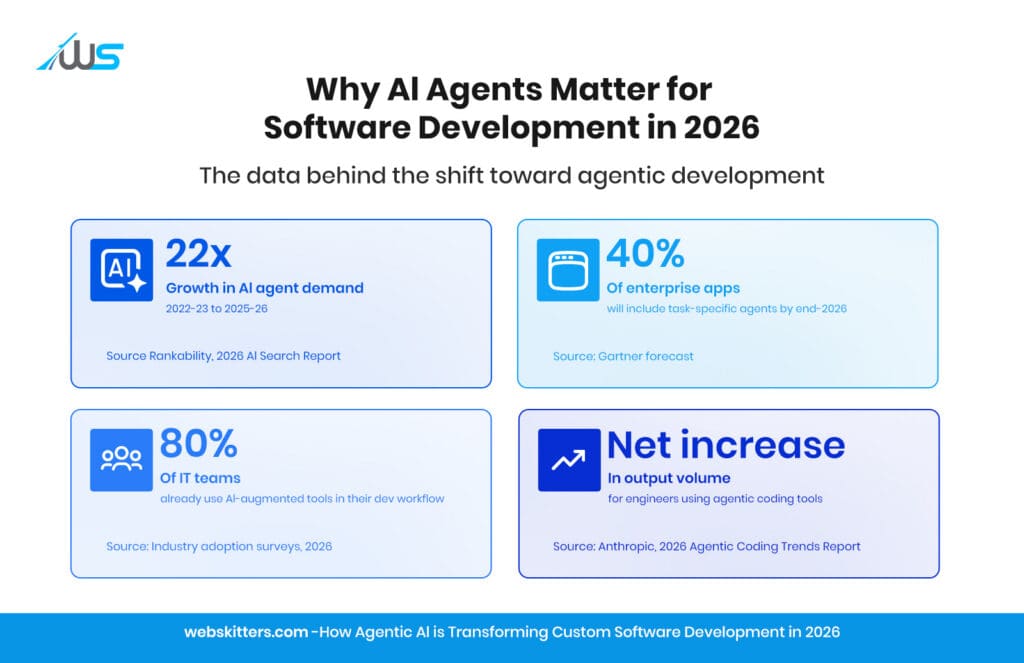
The numbers make this concrete:
- 22x growth in AI agent demand from 2022–23 to 2025–26, according to Rankability’s 2026 AI Search report
- 40% of enterprise applications will include task-specific AI agents by end-2026, per Gartner’s forecast
- 80% of IT teams already use AI-augmented tools in their development workflow
- Engineers using agentic coding tools report a significant net increase in output volume, per Anthropic’s 2026 Agentic Coding Trends Report
This is not about replacing developers. It is about giving each developer dramatically more leverage over what they can build and ship.
5 Ways AI Agents Are Transforming Custom Software Development
1. Agentic Code Generation and Review
AI agents can now write, test, and refactor code across entire feature branches — not just autocomplete a single line.
In practice, an agent receives a feature specification, reads the existing codebase to understand structure and conventions, writes the new feature code, runs the test suite and fixes failing tests, and commits a clean pull request for human review. Tools like Claude Code, Cursor Composer, and GitHub Copilot Workspace operate this way. Our engineering teams at Webskitters use agentic coding tools to accelerate feature delivery while maintaining code quality standards across client projects.
2. Automated QA and Testing Pipelines
Traditional QA is manual, slow, and expensive. AI agents change this by generating test cases from feature requirements, running regression suites after every commit, identifying edge cases the human QA team might miss, and writing and updating test documentation automatically. This cuts QA cycles from weeks to days for complex applications.
3. Intelligent Customer Support Agents
Custom AI agents can handle Tier-1 support at scale — answering product questions, processing routine requests, and escalating only genuinely complex issues to human agents. The key difference from old chatbots: these agents access live data (order status, user accounts, product databases) and complete actions like issuing refunds, updating records, or booking appointments. If you are exploring this for your business, our AI Chatbot Development team builds agents designed for exactly this kind of real-time, action-capable customer interaction.
4. Multi-Agent Workflows for Complex Business Processes
Multi-agent systems use an orchestrator agent to coordinate specialized sub-agents, each handling a specific part of a workflow in parallel. Consider a data processing pipeline where Agent A scrapes and ingests raw data, Agent B cleans and validates it, Agent C generates reports and visualizations, and Agent D sends alerts and summaries to stakeholders — all running in parallel.
Real-world results back this up. Zapier deployed 800+ internal AI agents with 89% adoption across the entire organization. Fountain used multi-agent orchestration to cut staffing time from weeks to under 72 hours — details on how orchestrated pipelines like these are designed are covered in Google Cloud’s 2026 AI Agent Trends report.
5. DevOps and Infrastructure Automation
AI agents are entering CI/CD pipelines, monitoring systems, and cloud infrastructure management — detecting anomalies and triggering rollbacks automatically, writing Infrastructure-as-Code from plain-language descriptions, and optimizing cloud resource allocation based on usage patterns. This is one of the fastest-growing adoption areas in 2026 enterprise IT.
Practical Steps: How to Integrate AI Agents Into Your Software Project
If you are evaluating AI agents for your business, a structured approach makes the difference between a successful pilot and a stalled proof-of-concept.
Step 1: Identify repetitive, rule-based tasks
Start with work that has clear inputs, clear outputs, and consistent rules. QA testing, data transformation, and support ticket routing are good starting points.
Step 2: Choose the right agent framework
Common options include LangChain, LlamaIndex, CrewAI, AutoGen, and Anthropic’s native tooling. LangChain’s documentation is a good starting point for understanding the framework landscape. The right choice depends on your tech stack and the complexity of your workflows.
Step 3: Define the tool set
What external systems will the agent need to access? Map out the APIs, databases, and services before development begins. The Model Context Protocol (MCP) is an emerging standard that simplifies how agents connect to external systems — worth understanding early in your planning.
Step 4: Build with human oversight first
Start with agents that surface recommendations for human approval before executing. Expand autonomy as you build confidence in reliability and edge-case handling.
Step 5: Measure and iterate
Track task completion rate, error rate, and time-to-output. AI agents improve with better prompts, more context, and refined tool access. Set a baseline before you launch.
Step 6: Partner with an experienced AI development team
Agentic systems require expertise in LLM selection, prompt engineering, tool design, and production-grade orchestration. Our AI Consulting team works with businesses to define the right architecture and scope before any build begins — helping you avoid the most common and costly mistakes in early agentic projects.
Common Mistakes and Misconceptions
Misconception 1: “AI agents will replace our developers.”
This is false. Agents eliminate repetitive low-value work so developers can focus on architecture, design decisions, and problem-solving that requires judgment. Skilled engineers become more productive, not redundant.
Misconception 2: “We can deploy a generic AI agent and get results.”
AI agents produce the best results when custom-built for your specific workflows, data, and toolset. Off-the-shelf agents handle generic tasks. Custom agents drive real business value.
Misconception 3: “AI agents are reliable enough to run unsupervised.”
In 2026, most production-grade agentic systems still require human review for high-stakes decisions. Reliability is improving rapidly, but designing appropriate checkpoints is still essential — especially in regulated industries.
Misconception 4: “This is only for large enterprises.”
SMBs are adopting AI agents rapidly. Low-code agent platforms have made deployment accessible to teams without large engineering organizations. The barrier is expertise in design, not infrastructure.
Misconception 5: “AI agents always need to be cloud-based.”
Edge deployment of smaller, specialized agents is now viable for latency-sensitive or privacy-first use cases, particularly relevant for businesses in healthcare, finance, and legal sectors.
FAQ: AI Agents in Software Development
1: What is the difference between an AI agent and an AI chatbot?
A: A chatbot responds to a single prompt with a text answer. An AI agent executes a sequence of actions — using tools, calling APIs, running code, and iterating on results — to complete a multi-step goal autonomously.
2: How long does it take to build a custom AI agent?
A: A simple task-specific agent can be built in 2–6 weeks. Complex multi-agent workflows for enterprise systems typically take 3–6 months depending on integration requirements, data access, and testing rigor.
3: What programming languages are used to build AI agents?
A: Python is the dominant language, used in over 52% of AI agent development projects according to Greenice’s 2026 research on 542 AI agent projects. JavaScript/TypeScript is common for web-integrated agents. Frameworks like LangChain, CrewAI, and AutoGen all run on Python.
4: Are AI agents secure?
A: Security is a critical design consideration. Well-built agents require explicit authorization scopes, audit logging, rate limiting on tool calls, and protection against prompt injection attacks. Choosing a development partner with security expertise built into their process is important.
5: How do AI agents connect to our existing software?
A: Through APIs and the Model Context Protocol (MCP) — an emerging standard that makes it easier to connect LLMs to external systems. Our AI Integration team handles this architecture for clients, mapping your existing stack to the agent’s tool set before a single line of agent code is written.
6: What is the cost of building an AI agent?
A: Costs vary widely based on complexity, number of integrations, and whether you need a proprietary LLM or can use API-based models. A focused discovery and scoping engagement is the right first step — it defines scope, de-risks the project, and gives you a realistic number before any commitment.
7: Will AI agents make our app development faster or more expensive?
A: For most custom software projects, agentic tools reduce development time by 30–50% on well-defined tasks. The investment in agent infrastructure pays back through faster delivery cycles and reduced human effort on repetitive work over the project lifetime.
Conclusion: The Takeaway
AI agents are no longer a future concept. They are a present-tense capability reshaping how software is built, tested, and deployed.
The businesses that win in 2026 and beyond will be the ones that move from asking ‘what are AI agents?’ to asking ‘which of our workflows should we automate first?’
Webskitters builds custom AI agents and agentic workflows for businesses across industries. Whether you are exploring a pilot or ready to build a production system, our AI Development and AI Consulting teams can help you define the right architecture and deliver measurable results. Get in touch with our team to start the conversation.

 UI/UX Design
  Web Development
  Mobile App Development
  Internet Of Things
  Game Development
  Artificial Intelligence
  Digital Marketing
  Data Science Consulting