 August 10, 2026
 What Is the Enterprise AI Stack?
The enterprise AI stack is the set of layered systems that turn a raw language model into a production business tool. On its own, an LLM only predicts the next token in a sequence. It has no memory, no access to your systems, and no way to complete a task that spans more than one exchange.
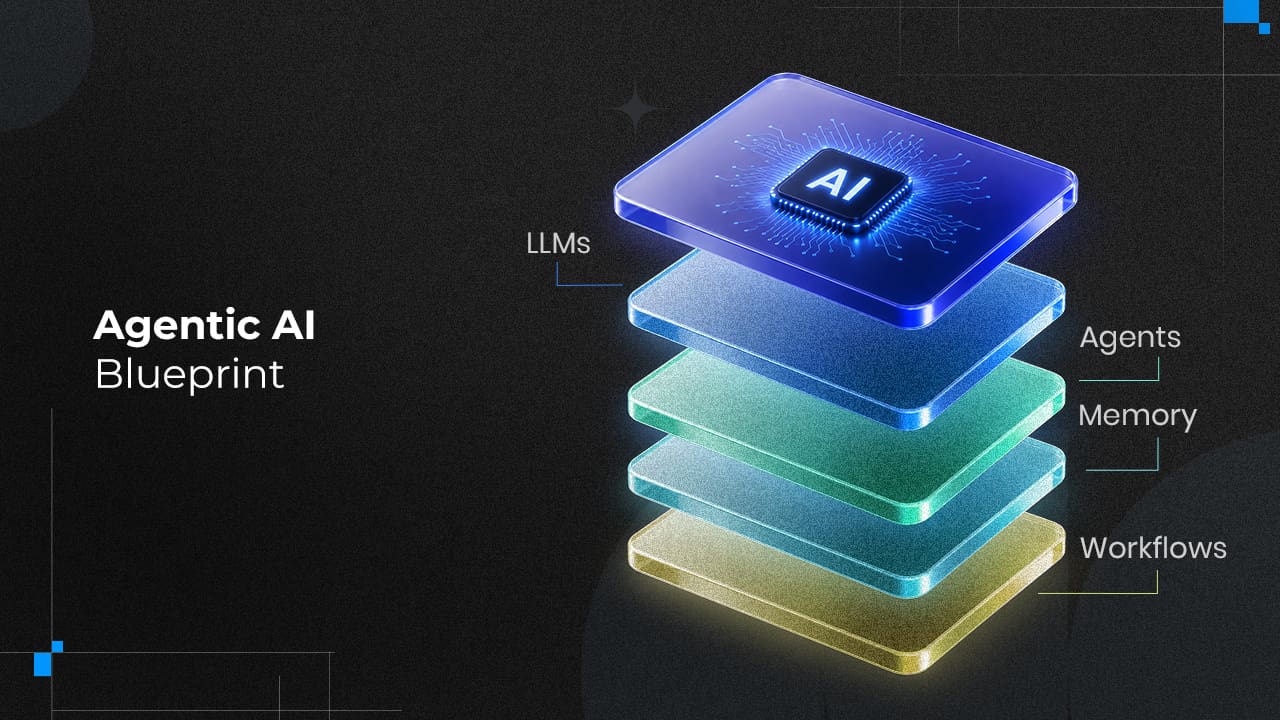
Industry architects generally describe the stack in four to five layers: the model itself, a decision and planning layer, tool and API access, an orchestration layer that sequences steps, and a memory layer that carries context forward. One widely cited breakdown, the five-layer IDEAL architecture, groups these as Intelligence, Decision, Execution, Action, and Learned layers. This article follows the same logic but keeps it to the four components teams actually budget for: LLMs, agents, memory, and workflows.
Layer 1: Large Language Models — The Reasoning Engine
The LLM is the core reasoning engine. It reads instructions, interprets context, and generates text, code, or structured output. In an enterprise stack, the model rarely works alone. It sits behind an API, receives a curated prompt, and returns output that other layers act on.
Three factors decide which model fits a given workload:
- Latency and cost per token, since agentic workflows call the model many times per task, not once.
- Context window size, which limits how much conversation history and retrieved data the model can reason over at once.
- Tool-calling reliability, because agents depend on the model choosing the right function with the right arguments, consistently.
Enterprises increasingly run more than one model in the same stack: a fast, cheap model for routine classification and a stronger model reserved for complex reasoning. This split keeps costs predictable as usage scales.
Layer 2: AI Agents — From Chat to Action
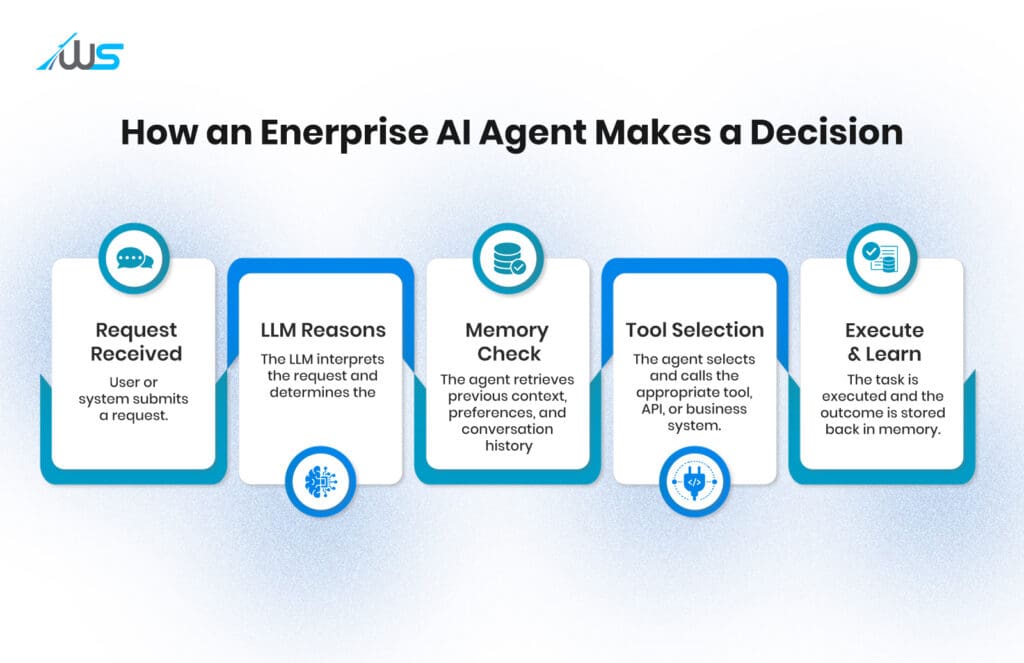
An agent is an LLM given the ability to decide what happens next: which tool to call, which document to fetch, which step to run. That single distinction separates a chatbot from an agent. A chatbot answers. An agent acts.
So, AI agents add an action-oriented layer to the enterprise AI stack, allowing systems to make decisions and execute tasks.
Enterprise use cases already leaning on this pattern include customer support resolution, IT ticket triage, contract review, and software engineering assistance. Businesses building conversational entry points into these agentic systems often start with AI chatbot development and expand into task-specific agents once the conversational layer is stable.
Adoption is accelerating fast. Gartner forecasts that 40% of enterprise applications will embed task-specific AI agents by the end of 2026, up from under 5% at the start of 2025 — an eight-fold jump in roughly a year. By 2035, Gartner projects agentic AI could drive close to $450 billion in enterprise software revenue.
Layer 3: Memory — Why Agents Need to Remember
LLMs are stateless by default. Every call starts from zero unless something outside the model reintroduces context. Memory is the architectural layer that fixes this, letting an agent recall a customer’s history, a project’s prior decisions, or a policy it applied last week.
Enterprise memory systems typically combine three types:
- Short-term memory — the active conversation or task context, held only for the current session.
- Long-term memory — facts and documents stored in a vector database and retrieved when relevant, often called retrieval-augmented generation.
- Episodic and procedural memory — records of past interactions and learned workflows that help the agent improve over repeated tasks.
This isn’t a niche concern. Atlan’s research on AI memory systems puts it plainly: agents that cannot remember are agents that cannot scale. Without persistent memory, every automated workflow degrades into a series of disconnected, single-shot tasks that keep asking the user to repeat themselves.
Layer 4: Workflows and Orchestration — Connecting the Pieces
Orchestration is the layer that sequences agent actions into a repeatable business process: pull the data, check the policy, draft the response, route for approval, log the outcome. Without it, an agent can reason well but still can’t reliably finish a multi-step job. This is the same discipline that shows up in broader web development trends toward automation-first architecture, applied specifically to AI-driven processes.
Teams generally pick an orchestration framework based on workflow complexity and how much failure recovery they need across long-running, multi-day processes:
| Framework | Best for | Key strength |
|---|---|---|
| LangGraph | Stateful, branching agent workflows | Graph-based control over agent decision paths |
| Temporal | Long-running, multi-day business processes | Durable execution with automatic failure recovery |
| CrewAI | Role-based multi-agent teams | Fast setup for agents that divide labor by role |
| Microsoft Agent Framework | Microsoft-stack enterprises | Unified SDK with built-in governance and telemetry |
Whichever framework a team picks, the orchestration layer is also where governance lives: audit trails, human-in-the-loop checkpoints, and cost tracking. Skipping this layer is the single most common reason agent pilots stall before reaching production.
Enterprise AI Stack Adoption: 2026 Data and Trends
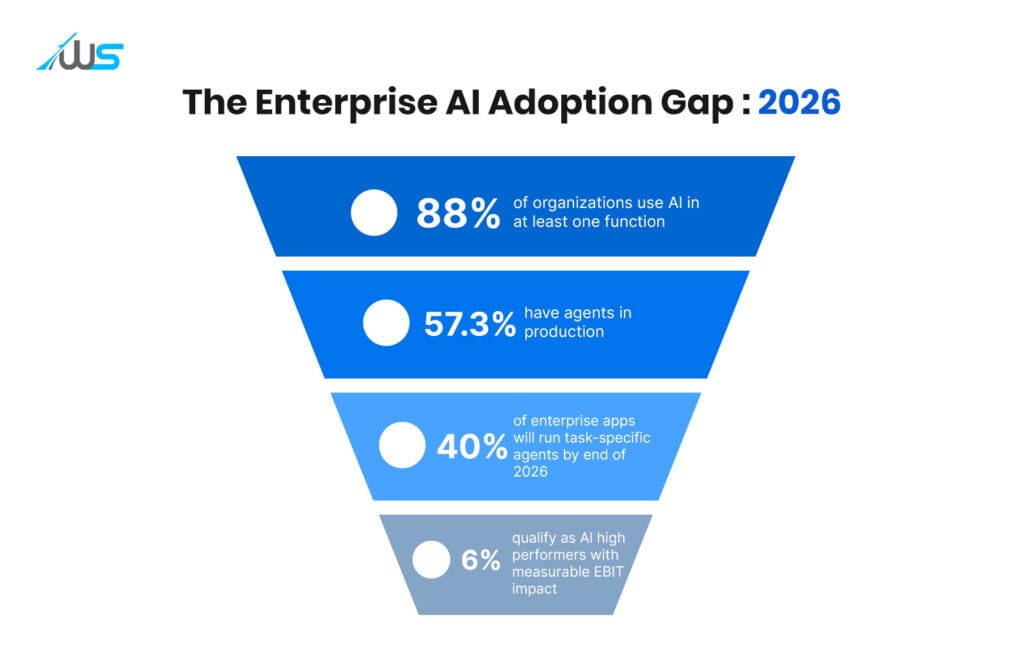
Adoption has moved past the experimentation phase, but scaled business impact is still rare. McKinsey’s State of AI 2025 report, based on nearly 2,000 respondents across roughly 105 countries, found that 88% of organizations now use AI in at least one business function, yet only about 6% qualify as AI high performers seeing more than 5% of EBIT attributable to AI.
Separately, LangChain’s 2026 agent engineering survey of over 1,300 professionals found that 57.3% of organizations already have agents running in production, with quality and latency named as the top two blockers to further scaling — both of which trace back to weak memory and retrieval design.
| Metric | Figure | Source |
|---|---|---|
| Enterprise apps with task-specific agents by end of 2026 | 40% (up from <5% in 2025) | Gartner |
| Organizations using AI in at least one function | 88% | McKinsey State of AI 2025 |
| Organizations qualifying as AI "high performers" | ~6% | McKinsey State of AI 2025 |
| Organizations with agents already in production | 57.30% | LangChain, 2026 |
| Agentic AI projects projected to fail by 2027 | 40% | Gartner (via Forbes analysis) |
| Projected agentic AI software revenue by 2035 | ~$450 billion | Gartner |
The gap between 88% adoption and 6% high performance is not a model problem. It is a stack problem: organizations deploying isolated pilots instead of a connected system of LLM, agent, memory, and workflow layers working together.
Common Pitfalls When Building the Enterprise AI Stack
- Skipping memory design: teams ship an agent, then discover it re-asks users for context it should already have.
- No orchestration layer: agents work in isolated demos but can’t chain steps together in a live business process.
- One model for every task: routing every request through the most expensive model inflates cost without improving accuracy.
- Missing observability: without tracing and cost tracking, teams can’t tell why an agent gave a wrong answer or where it stalled.
- Treating pilots as production: a working proof of concept still needs governance, audit trails, and human checkpoints before it touches real customers.
How to Build an Enterprise-Ready AI Stack
A stack that scales is built in order, not all at once:
- Start with one workflow. Pick a single, well-defined process — support ticket triage or invoice review — rather than automating everything at once.
- Choose the right model mix. Pair a fast, low-cost model for routine steps with a stronger model reserved for complex reasoning.
- Design memory before scaling agents. Decide what the system needs to remember, for how long, and where that data lives.
- Add orchestration and observability together. Sequencing logic and tracing should ship in the same release, not as an afterthought.
- Put governance in from day one. Human-in-the-loop checkpoints and audit trails are cheaper to build early than to retrofit later.
This sequence applies across industries, including regulated ones. Financial services teams building fintech software solutions, for example, need the memory and governance layers in place before an agent ever touches a transaction, not after.
Frequently Asked Questions
What is the difference between an LLM and an AI agent?
An LLM generates text based on a prompt and has no memory or ability to act on its own. An agent wraps an LLM with decision-making logic, tool access, and often memory, so it can complete multi-step tasks rather than just respond once.
Why do enterprise AI agents need a memory layer?
Without memory, every interaction starts from zero. Memory lets an agent recall prior conversations, decisions, and business context, which is what makes multi-day or multi-step workflows possible instead of repetitive one-off exchanges.
Which orchestration framework should we start with?
It depends on the workflow. LangGraph suits branching, stateful agent logic. Temporal fits long-running processes that need automatic failure recovery. CrewAI works well for role-based multi-agent teams. Microsoft Agent Framework is a strong default for teams already on Azure.
How long does it take to deploy an enterprise AI agent?
A single, well-scoped workflow can move from pilot to production in 8 to 12 weeks when memory, orchestration, and governance are planned upfront. Skipping that planning is the main reason timelines stretch far beyond that.
Why do most AI pilots fail to scale?
McKinsey’s research shows the gap is rarely the model itself. Most organizations run isolated pilots without redesigning the surrounding workflow, memory, and governance layers, so the pilot never becomes a durable, enterprise-wide system.
Final Thoughts
The enterprise AI stack works when its four layers move together: an LLM for reasoning, agents for action, memory for continuity, and workflows for structure. Skip one layer and the whole system feels unreliable, no matter how capable the underlying model is. Teams that plan all four from the start reach production faster and stay there. Explore more implementation guides on the Webskitters blog for hands-on breakdowns of the tools covered here.

 UI/UX Design
  Web Development
  Mobile App Development
  Internet Of Things
  Game Development
  Artificial Intelligence
  Digital Marketing
  Data Science Consulting