

 August 17, 2026
 A practical, data-backed look at why small language models and domain-specific AI are outperforming general-purpose LLMs on cost, speed and privacy for small and mid-sized businesses.
For three years the AI conversation was all about size: more parameters, bigger context windows, larger training runs. In 2026, the smarter question for small and mid-sized enterprises (SMEs) is a different one — which AI actually solves my problem without draining my budget?
Small Language Models (SLMs) and domain-specific AI systems — lean models trained on a narrow, purpose-built slice of data — are quickly becoming the default choice for SMEs that need fast, private, affordable intelligence rather than a general-purpose chatbot with an enterprise-sized inference bill. If you’re exploring where to start, Webskitters’ AI consulting team can help you map the right-sized model to the right business problem. This guide walks through what these models are, how they compare to large LLMs, where SMEs are using them, and how to get started — answering the questions SME owners are actually searching for in 2026.
Understanding Small & Domain-Specific AI Models
What Is a Small Language Model (SLM)?
An SLM is a transformer-based AI model with a parameter count typically ranging from a few million to around 7 billion — small enough to run on a laptop, an edge device, or a modest cloud instance, instead of a sprawling GPU cluster. SLMs trade some general-purpose breadth for speed, lower cost, and easier on-premise deployment.
What Makes an AI Model “Domain-Specific”?
A domain-specific model is fine-tuned (or built from scratch) on a narrow dataset drawn from one industry or task — medical records, legal contracts, retail catalogues, or customer-support transcripts — so it understands the vocabulary, edge cases, and workflows of that field far better than a generic model trained on “a bit of everything.”
Are SLMs and Domain-Specific Models the Same Thing?
Not always, but they overlap heavily. Most domain-specific enterprise deployments in 2026 are built on a small, open-weight foundation model (families like Phi, Gemma, or Llama) and then fine-tuned or paired with retrieval-augmented generation (RAG) for a specific business function — which is exactly the combination that keeps SME AI budgets under control.
Small AI Models vs Large LLMs: What the 2026 Data Shows
How Much Can SMEs Save by Choosing Small Models Over Large Ones?
Industry analysis shows SLMs can reduce operational AI costs by up to 60%, and a two-tier architecture — where an SLM handles the bulk of routine queries and only escalates the hard 20% to a large model — can cut total inference cost by 60–80%. Separately, OpenAI’s smaller GPT-4o mini was found to run roughly 60% cheaper than the older GPT-3.5 Turbo, illustrating the same size-to-cost curve across vendors.
Do Small Models Sacrifice Accuracy for Those Savings?
Less than most owners assume. A widely cited 2025 benchmark across 15 NLP classification tasks found a small DistilBERT-based model trailed GPT-4 by only about 2% in F1 score — a gap that wasn’t statistically significant — and actually beat the large model on recall (98.3% vs 96.5%) for sentiment classification, a metric that matters when missing a complaint or a critical ticket is costly. The pattern holds in healthcare too: a fine-tuned BioBERT model matched a frontier LLM on classifying chest X-ray report urgency. The takeaway isn’t that small models are smarter — it’s that specialisation, not size, drives accuracy on narrow tasks.
Yes. A 7-billion-parameter model runs comfortably on a single high-end GPU; quantised versions run on consumer-grade hardware; and 1–3-billion-parameter models run on ordinary CPUs. That means sensitive data never has to leave your premises or your own cloud VPC — removing the round-trip to a third-party server that worries many regulated SMEs in healthcare, finance, and legal.
Is the Market Data Backing This Shift Real?
It is, and it’s moving fast. Multiple research firms now size the global SLM market at roughly USD 10.65–11.1 billion in 2026, up from under USD 1 billion in 2025 — an order-of-magnitude jump in twelve months. Gartner projects that 40% of enterprise AI workloads will shift from cloud-hosted LLMs to SLMs by 2027, driven primarily by cost and data-privacy pressure. On the SME side, the U.S. Chamber of Commerce found small-business AI usage rose from 36% in 2023 to 89% in 2026 — and a large share of that growth is happening through lightweight, task-specific tools rather than frontier chatbots.
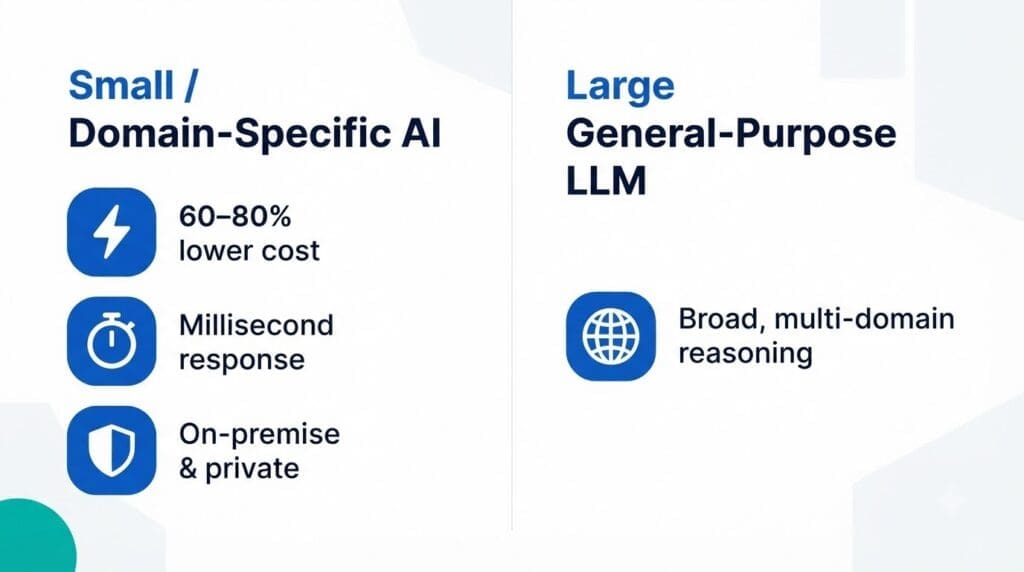
SLM vs LLM: A Quick Side-by-Side
| Factor | Small / Domain-Specific AI Model | Large General-Purpose LLM |
|---|---|---|
| Typical parameter size | Millions – ~7 billion | Tens to hundreds of billions |
| Avg. inference cost | Up to 60–80% lower per query | Higher; scales with token volume |
| Response latency | Millisecond-level, edge-capable | Higher; depends on network/cloud |
| Data privacy | Can run on-premise / in your VPC | Usually routed through external cloud |
| Accuracy on narrow tasks | Often equal or better once fine-tuned | Strong general accuracy, not always specialised |
| Best suited for | Focused, repetitive, domain-bound tasks | Broad reasoning, multi-domain, complex synthesis |
Most mature 2026 AI estates don’t pick one column over the other — they run a mixed-inference setup, using a small model for routine, high-volume work and reserving the large model for genuinely complex reasoning.
Where SMEs Are Actually Using Domain-Specific AI in 2026
Customer Support & Chatbots
A support-focused SLM fine-tuned on a company’s own knowledge base can now resolve roughly 80% of incoming queries instantly, with only the complex or novel 20% routed to a human or a larger model. This two-tier model is one of the fastest-growing use cases for SMEs building AI-powered chatbots in 2026.
Professional Services — Accounting, Legal, Consulting
58% of small professional-services firms now use AI, mostly for document automation, research assistance, and client communication.
Retail & E-Commerce
52% of small retailers use AI for inventory forecasting, personalised recommendations, and support chatbots.
Healthcare Practices
48% adoption, concentrated in scheduling, billing, and clinical documentation — areas where on-premise SLMs sidestep HIPAA-style compliance risk.
Manufacturing
On-device SLMs process natural-language equipment commands and flag sensor anomalies in real time, without sending factory-floor data to the cloud.
Do These Tools Need a Custom App or Website to Plug Into?
Usually yes — a domain-specific model is only as useful as the interface and workflow around it. Most SMEs pair their AI layer with a custom web or app development project so the model’s output (a chatbot reply, a recommendation, a document summary) shows up exactly where staff and customers already work.
Risks and Trade-Offs of Going Small
What Can Small Models Not Do Well?
SLMs generalise poorly outside their trained domain — a model fine-tuned for insurance claims will struggle with an open-ended marketing brainstorm. They also need clean, well-labelled domain data to fine-tune against, and they typically require periodic retraining as products, policies, or terminology shift.
Do SMEs Need In-House AI Expertise to Deploy One?
Some technical setup is unavoidable — model selection, fine-tuning, hosting, and monitoring all take know-how most small teams don’t have on staff. This is the single biggest barrier reported by SMEs: 73% say they would benefit from more implementation support, and only 14% describe AI as fully embedded in daily operations. Partnering with an AI development and integration partner is how most SMEs close that gap without hiring a full data-science team.

How to Get Started With Domain-Specific AI
- Pick one narrow, repeatable problem — support tickets, invoice classification, product tagging — rather than “AI for the whole business.”
- Audit and clean the domain data you already have (past tickets, catalogues, call transcripts) — fine-tuning quality depends on it.
- Choose an open small-model family (Phi, Gemma, Llama-class models) sized to your workload, or use retrieval-augmented generation if fine-tuning isn’t feasible yet.
- Decide on deployment: fully on-premise, in your own cloud VPC, or a hybrid where sensitive tasks stay local and general tasks call a managed LLM API.
- Pilot the triage-and-escalate pattern — let the SLM handle routine volume and hand off only what it can’t resolve.
- Monitor accuracy and retrain on a schedule as your data and business terminology evolve.
Frequently Asked Questions
1. Is ChatGPT a Small or Large Model?
ChatGPT runs on large, general-purpose frontier models built for broad reasoning across many domains — the opposite end of the spectrum from the lean, task-specific SLMs described in this guide.
2. Can a Small Business Realistically Train Its Own AI Model?
Full pre-training from scratch is out of reach for most SMEs, but fine-tuning an existing open small model on your own data — or using RAG to ground a small model in your documents — is achievable with the right technical partner and a modest budget.
3. What’s the Cheapest Way for an SME to Start With AI in 2026?
Start with a single, well-defined use case (like a support chatbot fine-tuned on your FAQ and past tickets) rather than a broad LLM subscription across the whole company. Narrow scope keeps both the fine-tuning cost and the ongoing inference bill small.
4. Will Small AI Models Replace Large Language Models Completely?
No — the 2026 pattern is coexistence, not replacement. Most production systems now mix both: an SLM for high-volume, narrow work, and an LLM reserved for the complex reasoning tasks that genuinely need it.
5. How Much Does It Cost to Build a Custom Domain-Specific AI Model in 2026?
Costs vary widely with data volume, hosting choice, and integration complexity, but fine-tuning an existing small open model is consistently cheaper than either training a large model from scratch or paying per-token for heavy frontier-LLM usage at scale. An AI consulting scoping call is the fastest way to get a realistic estimate for your specific use case.
The Bottom Line for SMEs
The AI race is no longer about who has the biggest model — it’s about who has the right-sized one. For SMEs in 2026, that increasingly means a small, domain-specific AI model: cheaper to run, faster to respond, easier to keep private, and, for well-defined tasks, just as accurate as its much larger cousins. The businesses winning with AI this year aren’t the ones with the most parameters; they’re the ones that matched the model to the problem.
If you’re ready to identify which parts of your business are ready for a small, domain-specific AI model — and which still need a broader LLM — talk to the Webskitters AI team for a scoped, right-sized AI roadmap built around your budget and your data.

 UI/UX Design
  Web Development
  Mobile App Development
  Internet Of Things
  Game Development
  Artificial Intelligence
  Digital Marketing
  Data Science Consulting


