 February 25, 2026
 On February 10, 2026, unconfirmed chatter began about a Google search ranking update. This was reported by reputable sites such as Search Engine Roundtable. This volatility, yet again, brought ethical SEO
into the spotlight.
We aren’t talking about Google’s official February 2026 update (Discover Core), which is still in process, according to official statements.
There has been a lot of discussion on the forums (WebmasterWorld and SearchEngineRoundtable). Some stated bot attacks and a rise in traffic. Others claimed a sudden drop in traffic and rankings.
While this volatility may be temporary, businesses can take the most practical step to avoid negative consequences: adhere to ethical SEO practices and invest in a professional SEO service that prioritizes long-term, guideline-compliant growth.
Do you want to know how to do it in the right way? Read on.
But, first things first, we need to know what ethical SEO is.
What is Ethical SEO?
Ethical SEO is the way of optimizing your website by strategies that adhere to guidelines, current legislation, and moral values.
For most, ethical SEO is adhering to White Hat SEO tactics only. For a selected few, it is about social equality, fairness, and transparency in digital space. For us, it’s both.
“SEO is not about gaming the system anymore; it’s about learning how to play by the rules.” — Jordan Teicher, Director of Creative Strategy at The Atlantic.
Surprisingly, some experts also suggest that ethical SEO isn’t feasible. But why do some experts believe that?
It is a well-known fact that Google dominates the search engine landscape, accounting for 89.6% of the global search market. While the share fell below 90% for the first time in 2024, it is still one of the most popular search engines in the world.
Google’s ethical foundation has been questioned again and again. Are the Google algorithms biased? That comes down to whether the search results are fair and ethical.
Before delving deep into the question, it’s important to be clear about every aspect of SEO.
Explore More: Search Engine Optimization (SEO): The Complete Guide to Ranking, Traffic & Growth in 2026
Are Search Engine Algorithms Biased?
To answer this question, we have to look at a situation that happened in 2010.
According to NBC, Safiya Noble, a communications scholar, was searching for sites that showcased the history, pop culture references, and educational content on Afro-American girls.
The first Google page that appeared when she searched “black girls” was filled with illicit and vulgar content, instead of educational or historical content. So, the term was not defined by aspirations, interests, or history; it was defined by vulgarity.
But what accounts for such bias?
The majority of people attribute this bias to failure, glitches, or popular search patterns. But, it is more than that.
Firstly, we have to understand a few things.
-
Google (or other search engines) isn’t an impartial arbiter. It is created by the people, for the people. So, this bias cannot be attributed solely to the searchers but also to the designers.
-
As Nobel stated, Google doesn’t strive to provide users with unbiased or trustworthy information. It promotes content pieces that are optimized mostly by ads. It is a known fact that Google generates most of its revenue from ads.
Even in 2023, Alphabet Inc., which is Google’s parent company, generated ad revenue of 237.9 billion USD. Of this, nearly 73% of the revenue (about 175 billion USD) came from Google.
Other instances also showed this bias. In 2016, Carole Cadwalladr searched for information about the Holocaust.
The search term “Did the Holocaust happen?” showed her anti-Semitic websites like Stormfront. So, Google prioritized popular results over reliable ones like Wikipedia. This organization of websites by popularity was being done to appeal to advertisers.
After a decade of updates, today, Google focuses on E-E-A-T and topical authority. It has laid out clear guidelines that prioritize user experience above all else.
Learn More: How to Build Topical Authority with EEAT to Boost Rankings
Some Google algorithm updates result in a drop in the rankings of even high-quality websites. This is a major indicator of Google’s bias, even today. And, it raises further questions about the neutrality of this search engine.
Can We Have an Unbiased Search Engine?
This has been the talk of the town for a long time now. Not only SEO executives but developers and designers have also been asking this question.
Right now, complete neutrality is quite challenging, if not impossible, for search engine algorithms. That’s because these algorithms are complex and often subject to human biases.
Practically, no algorithm can be purely objective. Because these algorithms are designed to rank content, they can never be entirely neutral.
Even studies showed that bias is always present in search engines. And when it comes to effective, well-intentioned algorithms, they cannot produce unbiased outcomes.
Unethical SEO vs. Ethical SEO
As we can see, search engines (like Google) can’t always produce unbiased results; SEO executives are responsible for making Google a neutral space.
For that, it is recommended to use White Hat SEO tactics.
But it’s not only the SEO experts’ role to make search engines safer. Users also have a part to play.
Whenever we encounter impartiality in SERPs, we need to report the rankings and share them with others in our network.
Content developers and digital marketers also need to understand these biases and create content that makes search engines as neutral as possible.
But first, we need to understand the difference between ethical and unethical SEO.
We have already discussed what ethical SEO is. Let’s explore unethical SEO.
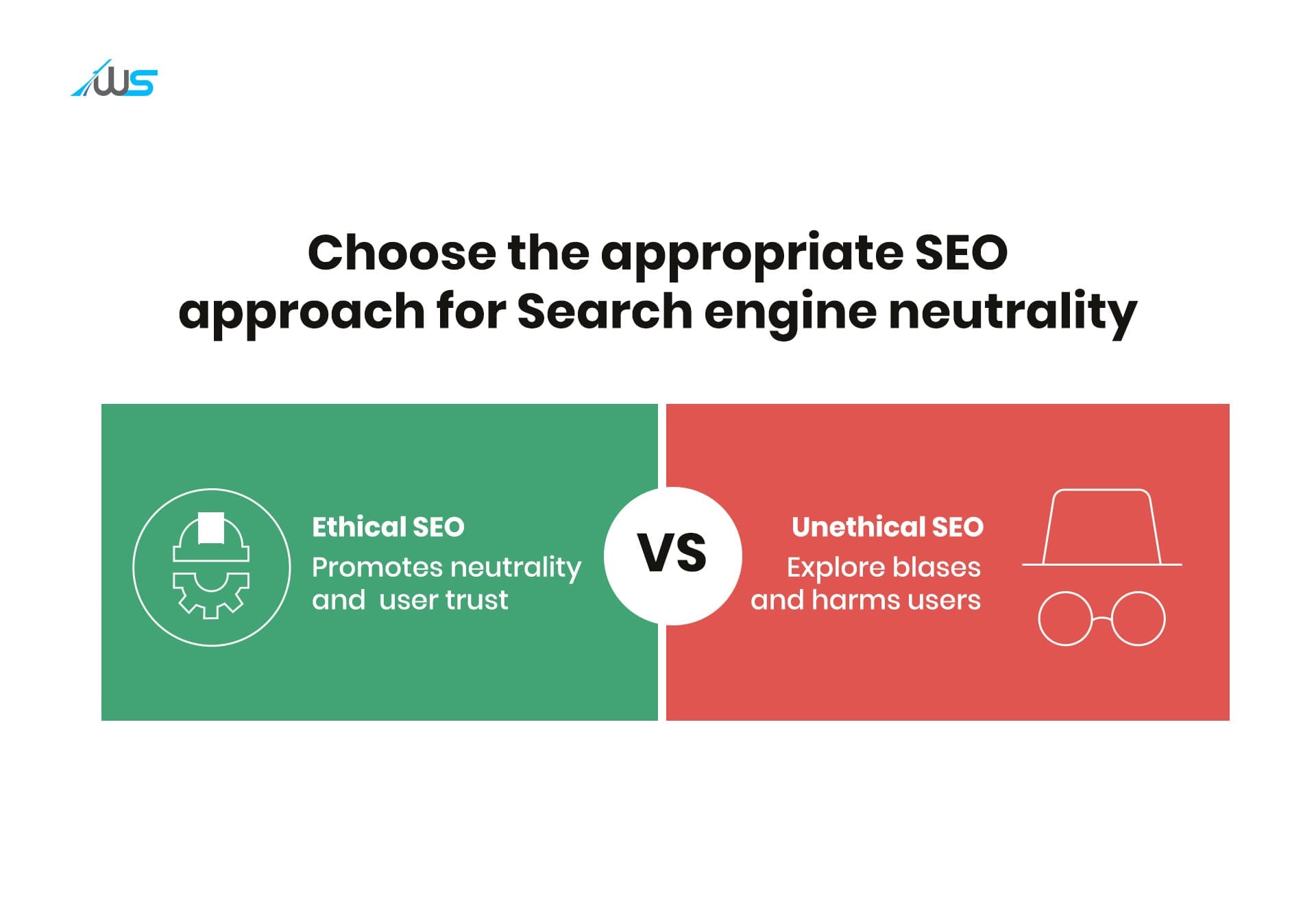
What is Unethical SEO?
Unethical SEO is the set of techniques and practices that manipulate search engines to rank higher on SERPs.
Unethical SEO is commonly called Black Hat SEO or simply Spam. These practices aren’t always illegal, but are manipulative and unprofessional. Black Hat SEO practices are frowned upon because of their sneakiness.
It’s all about below-the-belt practices, cheating, and cutting corners with only one particular objective: to rank the website immediately.
How does Black Hat SEO work?
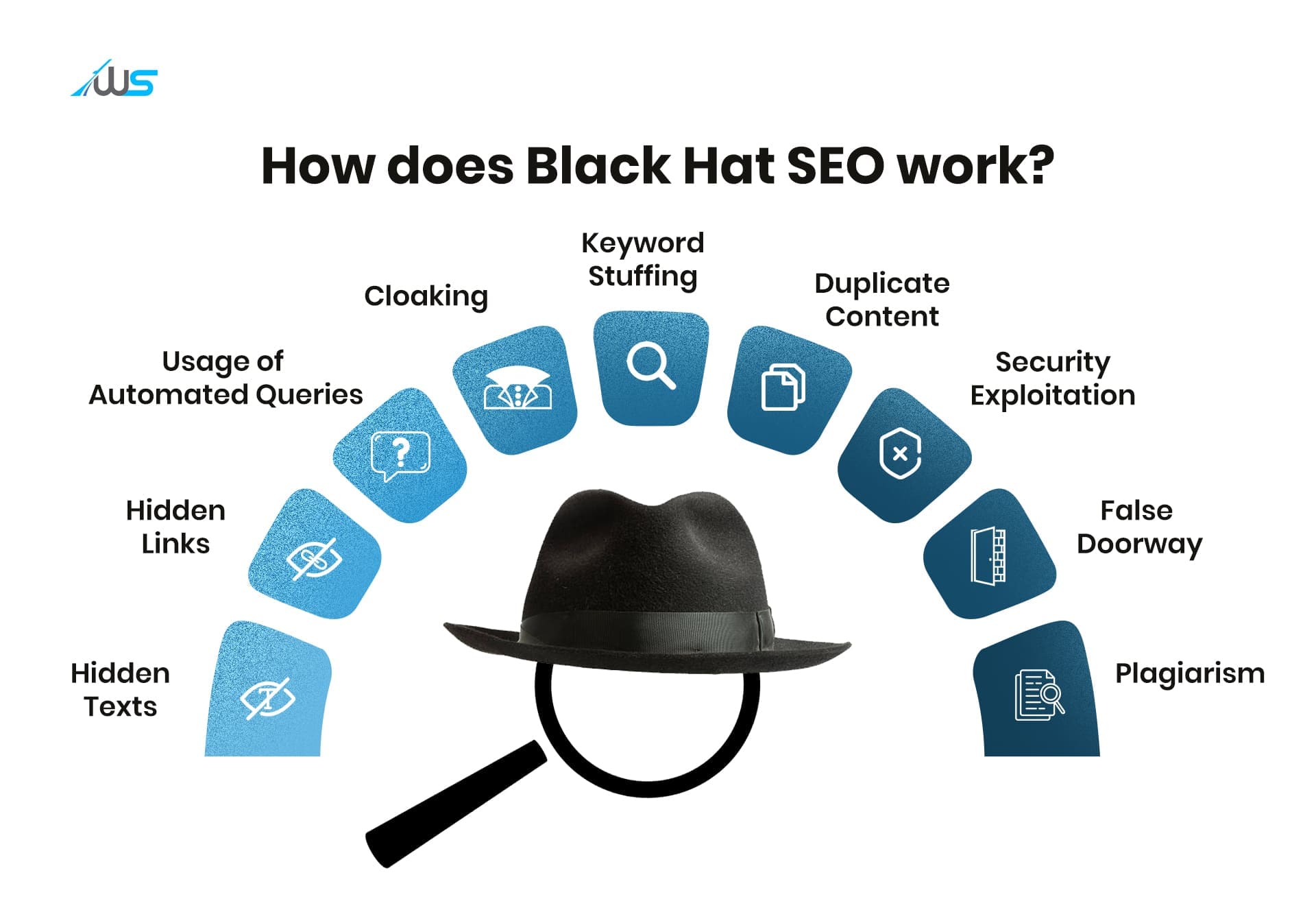
Certain unethical techniques are employed in Black Hat SEO. Some of them are:
-
Hidden Texts: Sometimes texts are hidden behind images or backgrounds. Zero fonts are also used to hide texts.
-
Hidden Links: Certain links are also hidden from the users. Sometimes, these links are made indistinguishable from the rest of the content.
-
Usage of Automated Queries: Automated queries are also used without proper permission from the search engines.
-
Cloaking: In this process, content is submitted so that the text becomes unclear to the target audience.
-
Keyword Stuffing: This technique involves overusing keywords on a webpage or website. This hampers the site’s overall UX but ranks it well in a short span.
-
Duplicate Content: Content is repeated and posted to manipulate search ranking.
-
Security Exploitation: Viruses or malware may be installed on the website. So, when visitors enter the site, they are infected by it.
-
False Doorway: False doorways can be incorporated into a website that leads users to other websites with irrelevant links attached.
-
Plagiarism: Automated or auto-generated content and plagiarized content with a substantially high keyword density..
It is important to note that all these tactics can be detrimental to a website. Incorporating Black Hat SEO tactics can lead search engines to penalize your site. Plus, it can also blacklist the website from that particular search engine.
According to Search Engine Land, AI Search has opened doors to large-scale manipulation. So, knowing all this is necessary to avoid getting penalized by search engines like Google.
Let’s discuss the White Hat SEO strategies one should incorporate to stay on the ethical side of things.
Strategies to Adhere to Ethical SEO Practices
Before we discuss White Hat SEO practices, we need to understand what Grey Hat SEO is.
Grey Hat SEO sits at the boundary of Ethical and Unethical SEO. So, these practices linger on the verge of shady and accepted tactics.
Some of these tactics include:
-
Backlink purchases
-
Backlink building at low-quality sites
-
Partially spun content
-
Participating in forums just for adding links
-
Partial cloaking
-
Parasite SEO
-
Domain squatting
Note: All these Grey Hat SEO practices are subjective and depend on the opinions of the SEO experts who use them. Some of these practices are penalized by Google, too.
Do you want to learn about some awesome Ethical SEO practices to optimize your website responsibly? Let’s discuss some ways to do that.
How to do White Hat SEO?
1. Making the User Experience Truly Exceptional
White Hat SEO is all about prioritizing the users. From a technical perspective, ethical SEO is simply about providing the best UX to everyone who visits your website.
Our advice? To make the website UX exceptional, focus on:
-
Fast Load Times
-
Highly Responsive Design
-
Intuitive Navigation
-
Accessibility
-
Transparency and ethical data usage
-
Localization
2. Publishing Content that Adds Value
Today, the digital landscape is filled with indifferent content pieces. Be it health advice, tech trends, the moon, the stars, and whatnot; you name it, and you get it, all in the name of ranking for a competitive keyword.
But how do you know if it is written by an expert? Does it give out any value?
That’s the need of the hour: provide relevant, valuable content to users. You have to do your best to publish content that is written by experts. You can even outsource this task to a reputable digital marketing company.
Another way to rank for competitive keywords is to provide unique insight into a popular search topic.
In any case, your priority should be to provide quality content to your audience.
3. Natural Backlinks Work the Best
Every SEO expert wants to boost website rankings through backlinks. However, in reality, what matters is the connection with users. People love valuable content and genuine backlinks that link to meaningful references.
When going through a piece of content, the user needs fun facts, stats, studies, and so on. This makes them trust the content’s perspective and also makes the read super-engaging. Here, backlinking works the best.
And, it’s a proven fact that long-form content gets more clicks (around 77% more) than short-form content. Furthermore, if you backlink, it will build your topical authority (in line with Google’s E-A-T).
4. Fresh and Fast Website is the Best Tactic
It’s not recommended to redesign your website completely to keep it fresh and appealing. In fact, this can undermine all the SEO you’ve done until this point.
However, revamping the website’s content with fresh, relevant assets and information can make it feel more up-to-date and relevant.
All these small improvements can boost organic traffic (and ROI even more). Plus, you can run some A/B testing to find out what’s working and what’s not instead of randomly creating content.
But one thing is clear. If you make relevant and engaging content, the users will keep coming back for more.
Want to do Great SEO Together?
The internet is rife with competition. Every business is basically competing with other businesses online. SEO is a strategy that almost every business incorporates for its cost-effectiveness.
This makes the SEO landscape more competitive than any other marketing strategy. So, it’s quite tempting for businesses to resort to unethical SEO practices to stand out. This has serious problems, ranging from moderate penalties to complete blacklisting by search engines.
That’s why ethical SEO is important from a business perspective. However, on the individual level, it’s everyone’s duty to keep the digital space as safe as possible. And, for that, ethical SEO practices are the foundational steps.
Do you want to adhere to ethical SEO without any confusion? Webskitters is here for you.
Book a call with us and let’s develop exceptional SEO strategies together.

 UI/UX Design
  Web Development
  Mobile App Development
  Internet Of Things
  Game Development
  Artificial Intelligence
  Digital Marketing
  Data Science Consulting