 May 29, 2026
 Every business wants to move faster with AI.
Some want AI chatbots to reduce support load. Some want generative AI to speed up internal workflows. Some want intelligent automation to improve productivity. And some want custom AI systems that can transform how the business operates.
But before choosing a tool, platform, or development partner, businesses need to answer a more important question:
What part of this AI system should we actually own?
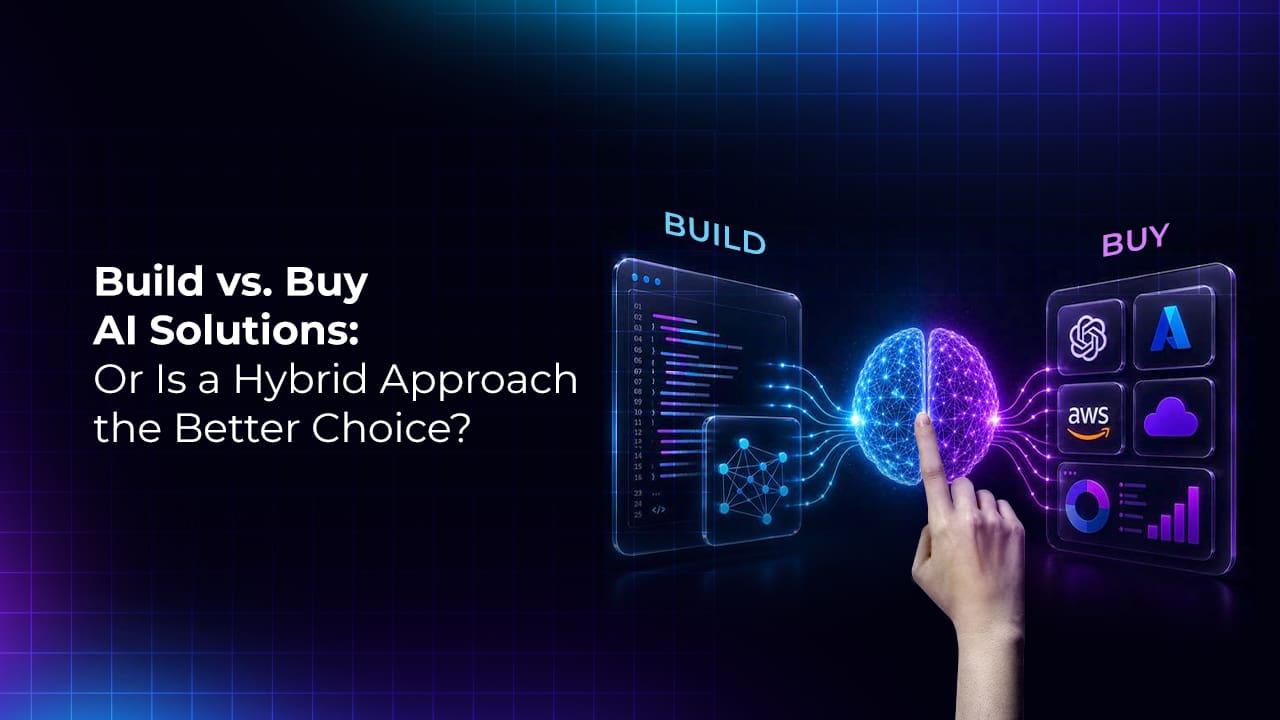
Because the build vs. buy AI solutions decision is not just about cost. It is about control, speed, scalability, data, governance, and long-term business value.
And in many cases, the answer is not simply “build” or “buy.”
It is blend.
AI Adoption Is Accelerating, But Value Creation Remains the Challenge
AI is no longer a future investment. It is becoming a present-day business requirement.
According to the Stanford AI Index Report 2025, organizational AI adoption continues to rise as businesses move from experimentation to implementation. At the same time, McKinsey’s State of AI Report found that 78% of organizations now use AI in at least one business function, while generative AI adoption has more than doubled in recent years.
Yet adoption alone does not guarantee success.
Many organizations successfully launch AI pilots but struggle to generate measurable business value because of challenges related to governance, integration, ownership, security, and scalability.
This is exactly why the build-versus-buy conversation has become more important than ever.
The Old Build vs. Buy Question Is Too Simple
Traditionally, businesses compare build vs. buy using a few familiar points:
- Cost
- Speed
- Customization
- Scalability
- Maintenance
- Time to market
That looks neat on paper.
But modern AI solutions do not work like a normal software purchase.
An AI solution is not one single block. It is made of several layers:
- Business data
- AI models
- Prompts
- Workflows
- Integrations
- User interfaces
- Security controls
- Governance rules
- Monitoring systems
- Feedback loops
One weak layer can affect the entire experience.
For example, a company may buy a ready-made AI chatbot. It may respond quickly. It may look impressive in a demo. But what happens when it needs to understand refund rules, access CRM data, escalate sensitive queries, or follow compliance checks?
That is where the real AI work begins.
The model may be bought.
But the business logic may need to be built.
Build vs. Buy vs. Hybrid AI Solutions Comparison
| Factor | Buy AI Solutions | Build AI Solutions | Hybrid AI Solutions |
|---|---|---|---|
| Time to Launch | Fast | Slow | Moderate |
| Initial Investment | Low | High | Medium |
| Long-Term Cost Control | Limited | High | High |
| Customization | Low | Very High | High |
| Data Ownership | Limited | Full | Full |
| Security & Compliance Control | Moderate | High | High |
| Scalability for Complex Workflows | Moderate | High | High |
| Vendor Dependency | High | Low | Low |
| Internal Resource Requirement | Low | High | Medium |
| Best For | Standard use cases | Competitive differentiation | Speed with control |
The table highlights why the build-versus-buy discussion is no longer a binary decision. Many organizations are discovering that hybrid AI offers the best balance between speed, flexibility, and long-term ownership.
Buying AI Makes Sense When Speed Matters
There is nothing wrong with buying AI.
In fact, for many standard use cases, buying is the practical choice.
For many organizations, off-the-shelf AI solutions for business provide a fast way to experiment with automation, improve productivity, and validate use cases before committing to larger investments.
If your team needs:
- Meeting summaries
- Document search
- Content assistance
- Basic customer support
- Productivity automation
An existing AI platform can help you start quickly.
Buying works well when:
- The use case is common.
- The workflow is simple.
- The risk is low.
- The tool does not need deep customization.
- Your process can adapt to the product.
This is why many businesses start with off-the-shelf AI. It reduces early effort and helps teams test adoption before making larger investments.
But there is a catch.
Buying AI gives speed.
It does not always give control.
Building AI Makes Sense When Control Matters
If AI sits close to your business advantage, customer experience, sensitive data, or operational decision-making, building becomes more important.
This is especially true for AI solutions for business that directly influence customer interactions, regulatory compliance, financial decisions, or mission-critical operations.
Why?
Because your business may need to control:
- How the AI behaves
- What data it uses
- When humans review outputs
- How exceptions are handled
- How the system improves over time
Think about AI in:
- Finance
- Healthcare
- Logistics
- Insurance
- Legal services
- Enterprise customer support
A wrong answer in these industries is not just inconvenient.
It can create compliance, security, operational, or reputational risk.
Building AI makes sense when you need:
- Custom workflows
- Proprietary data usage
- Deep system integration
- Strong security controls
- Human-in-the-loop approvals
- Long-term ownership of logic and improvements
Yes, building requires more planning and investment.
But when AI becomes part of how your business competes, serves customers, or makes decisions, control is not optional.
It becomes strategic.
Understanding the True AI Solutions Cost
Buying AI usually looks cheaper at the beginning.
A subscription fee feels predictable.
The setup looks simple.
The launch timeline looks shorter.
But the real AI solutions cost extends far beyond software licensing.
Organizations must also account for:
- Integration costs
- Security implementation
- Governance frameworks
- Employee training
- Change management
- Monitoring and maintenance
- Workflow redesign
- Ongoing optimization
Many organizations focus on pricing but underestimate the operational effort required to make AI successful inside real business environments.
The real cost often appears later.
- More users
- Higher usage volumes
- Premium features
- Additional integrations
- Compliance requirements
- Vendor dependency
- Scaling limitations
Suddenly, the tool that looked affordable starts becoming expensive.
On the other hand, building AI has a higher upfront investment.
You need:
- Discovery
- Planning
- Development
- Data preparation
- Testing
- Deployment
- Monitoring
- Maintenance
But if the AI system supports a core business function, the long-term value can be stronger because you own the logic, roadmap, and improvement cycle.
When evaluating AI solutions cost, decision-makers should compare both short-term implementation expenses and long-term business value.
The better question is not:
“Which option is cheaper today?”
It is:
“Which option creates better value over the next 24 to 36 months?”
Speed to Launch Is Not the Same as Speed to Value
Buying AI helps businesses launch faster.
But launching fast does not always mean creating value fast.
A tool may go live quickly, but if it does not fit existing workflows, teams may not trust it.
Employees may:
- Double-check every response
- Continue manual processes
- Create workarounds
- Treat AI as an experiment rather than a business tool
That is not adoption.
That is friction.
Building or customizing AI may take longer initially, but it can create stronger adoption because the system fits the way people actually work.
This is where many AI pilots fail.
They move quickly to launch.
But they move slowly toward measurable business outcomes.
Scalability Is More Than Adding Users
Many AI platforms scale well technically.
You can add users.
You can increase usage.
You can purchase more features.
But operational scalability is different.
What happens when:
- One use case becomes ten?
- One department becomes five?
- The AI needs different access permissions?
- Compliance requirements increase?
- Reporting requirements become more complex?
This is where generic AI tools often begin to show limitations.
Scalable AI is not just about handling more volume.
It is about continuing to deliver business value as organizational complexity grows.
That requires:
- Architecture
- Governance
- Integration
- Security
- A clear AI roadmap
Why Hybrid AI Is Often the Smartest Route
For many businesses, the best answer is not building everything or buying everything.
It is a hybrid approach.
A hybrid model is increasingly becoming the preferred strategy for organizations seeking AI solutions for business that balance speed, flexibility, and control.
In a hybrid AI model, businesses use proven AI platforms and models where they already perform well.
Then they build custom business layers around them.
For example:
A company may use a commercial large language model but build custom workflows for:
- Customer support
- Refund approvals
- CRM integration
- Compliance checks
- Internal knowledge access
- Human review processes
This approach delivers speed without forcing the business into generic workflows.
You do not reinvent what already works.
But you do not surrender the parts that make your business unique.
That is the real advantage of hybrid AI.
The Organizations Winning With AI Think Beyond Tools
Recent enterprise AI research reveals a consistent pattern.
The organizations generating the strongest returns from AI are not necessarily the ones using the most AI tools.
They are the ones successfully integrating AI into core business operations.
They focus on:
- Governance
- Workflow integration
- Employee adoption
- Data quality
- Measurable outcomes
The biggest differentiator is not AI adoption.
It is AI ownership, execution, and operational alignment.
Final Takeaway
Build vs. buy AI is not a technical argument.
It is a business ownership decision.
- Buy when the use case is simple, standardized, and low risk.
- Build when AI directly impacts competitive advantage, customer experience, or sensitive operations.
- Choose hybrid when you need speed but cannot afford to lose control.
The future of AI will not belong to businesses that adopt the most tools.
It will belong to businesses that know what to own.
The most successful AI solutions for business are not necessarily the most advanced.
They are the ones that align with business goals, operational realities, governance requirements, and long-term growth strategies.
Need help choosing the right AI path for your business?
Consult Webskitters‘ AI experts and build an AI roadmap tailored to your data, workflows, compliance requirements, and growth objectives.

 UI/UX Design
  Web Development
  Mobile App Development
  Internet Of Things
  Game Development
  Artificial Intelligence
  Digital Marketing
  Data Science Consulting