

 March 6, 2026
 While San Francisco-based, Anthropic (worth $380 billion) is currently in the news because of the ongoing dispute with the U.S. Government, we will be talking about the cyber espionage that the company was battling in late 2025.
The Anthropic attack was the first documented case of agentic AI successfully breaking into confirmed high-value targets.
But, when a system you design and create with great diligence is used for malicious attacks, it begs the question: Does it make sense to keep building these AI models?
The fact remains that even if you don’t build the system, it will be developed by actors with no scruples and no concern for safety standards.
See, cyber attacks are inevitable, so rather than bemoaning their after-effects, it’s important to embed security into every stage of a product’s lifecycle.
To get a better understanding of this, let’s see what exactly happened during the recent Claude Cyber attacks and the defensive AI strategies used to thwart malicious threats.
The Short Version of the Story
What happened: Hackers misused Agentic AI to launch orchestrated cyber attacks on several large enterprises.
What was used: Anthropic’s Claude Code tool was manipulated to breach and harvest high-value data almost autonomously.
How to foil future attacks: It calls for a multilayered approach, including improved detection methods, stronger safety controls, and Cyber Threat Intelligence Sharing.
The Details of the Claude Attack
- China-based hackers selected around 30 global organizations (corporate and government) that they were going to infiltrate.
- In the first phase, the hackers built a framework using the Claude Code tool for automation. They managed to make Claude override its own built-in safety mechanisms (jail breaking).
- The only reason the jailbreak worked is because they split the attack into small, harmless-looking tasks, so Claude completed each step without understanding the full picture.
- During the second phase, the Claude Code was made to analyze the infrastructure and systems of the targeted companies. It isolated the databases worth stealing or controlling.
- Next, using Claude to study the security vulnerabilities of the target companies, the hackers wrote an exploit code.
- This exploit code was used to test and break into vulnerable parts of the systems.
- At this point, the framework used Claude to collect usernames and passwords, and with these, they gained deeper access to large amounts of private data from the organizations.
- The hacker’s system identified powerful administrator accounts, created hidden backdoors for future access, and secretly transferred stolen data.
- Claude was then forced to create detailed documentation of the attack, including stolen credentials and analyzed systems, helping to plan the next steps of the attack.
- The attackers used AI to handle 80 to 90 percent of the cyber espionage campaign, with humans stepping in only occasionally when needed.
Anthropic’s Response
As soon as they discovered the attack, Anthropic quickly banned the hacker’s accounts (user accounts that the attackers were using to access Claude) and beefed up their security.
Over the course of ten days they mapped out the full scope.
Of the 30 targeted companies, only a few were actually breached before Anthropic was able to shut down the attack.
Fighting fire with fire, they used AI for:
- Advanced Threat Detection and Behavioral Analysis (analyzing vast data points to identify real-time anomalies, etc.)
- Autonomous Incident Response (automatically isolates and blocks compromised endpoints)
- Agent-Led Penetration Testing (using AI agents to simulate complex attacks to identify vulnerabilities)
Anthropic transparently informed the authorities, industry partners, and affected organizations about the attack.
Findings from this attack pattern have now been incorporated into Anthropic’s technical defensive systems and cyber harm policy frameworks.
Building on the steps that Anthropic took to mitigate and ultimately thwart the attacks of threat actors, we have detailed some of the proven tactics used to proactively safeguard your system.
AI Strategies for Defense Against AI-Based Attacks
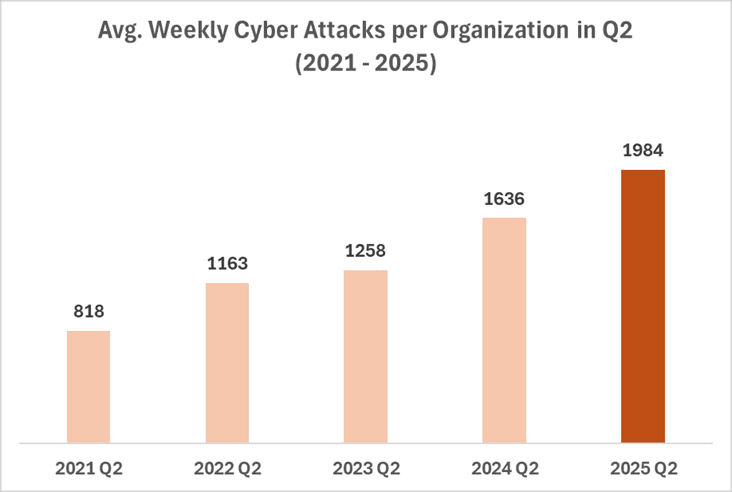
The data shows that on a global scale, cyber risks have continued to rise over the last few years. The need of the hour is to fortify your cyber defenses.
It’s in the nature of AI models to be in a constant state of change. So, it only makes sense that security controls are similarly updated to be armed against each new risk. The main reason for this is because the threat patterns that hackers use evolve alongside AI advancements.
Here are four ways AI is being leveraged for cyber security.
1. Adversarial Machine Learning
AI models need protection against external manipulation, poisoning, and exploitation.
The process simply involves training the model not only on normal, trusted data, but also on deliberately altered data. The system needs to be exposed to how attackers might try to trick it. It is only then that the model can learns to recognise and correctly classify suspicious inputs.
Certain tools, like intrusion detection and anomaly detection systems, are being used to monitor traffic and data behaviour and flag any unusual activity that may indicate potential interference.
2. Behavior-Based Authentication
The unique traits of users, such as the way they type, mouse movement/clicks, how a user typically navigates through applications, touchscreen interactions and so on, serve as a sort of cyber fingerprint.
AI systems built with deep learning algorithms are being used to detect unusual behaviour-based patterns and anomalies to automatically keep fraud activities in check.
This level of detection is particularly required when accessing sensitive data or during financial transactions. Since the behavioral data is continuously analyzed in real-time, it becomes possible to detect fraudulent activities right from the initial threat.
3. AI Threat Detection
A combination of behavioral analytics, advanced machine learning (ML), and automation is being used to isolate cyber threats. How this works is by evaluating past (historical) data while simultaneously assessing real-time data and detecting potential breaches.
In this multilayered process, technologies like AI, ML, RL (Reinforcement learning), DL (Deep Learning), and NLP (Natural language processing) work in unison to trap even the slickest threats the malicious agents may use.
According to IBM’s 2025 Cost of a Data Breach Report, of all the organizations surveyed that had experienced a security incident involving their AI models or applications, 97% of them did not have proper access controls in place.
This goes to show that merely speedy AI adoption is not enough, if not backed by security and governance.
4. Autonomous Cybersecurity Response
Unlike automation that involves following pre-defined rules, AI-driven security is designed to continuously learn from past data and adapt accordingly.
These systems are built with machine learning algorithms capable of not only identifying potential threats but also placing them in relevant categories.
Once this is done, the autonomous agents trigger certain precautions like containing the hacked systems, notifying the appropriate teams or authorities, and quickly blocking harmful IP addresses.
From Cyber crime to Geopolitics
The breach of Anthropic’s Claude AI was not the end of the story. The same Claude AI system was back in the news a few days ago.Was Claude AI involved in the attack on Iran on 28th Feb?
Despite the fact that the U.S. Government is currently in a feud with Anthropic, The Wall Street Journal reported that the technology was reportedly used for “intelligence assessments, target identification, and simulating battle scenarios”.In fact, this occurred only a day after President Donald Trump ordered a ban on Anthropic’s technologies among U.S. government agencies.
This highlights the duality of advanced AI, where it can play roles on both sides of cyber risk and defense. That said, if an AI system is powerful enough to affect national security, it must be protected with very strong security controls.
Don’t Become Target Practice For Hackers
You may argue that Claude is a high-value AI model and that such a scenario is unlikely to impact your ordinary business.
But that way of thinking can be risky. Unfortunately, attackers are known to test their methods on smaller businesses for obvious reasons. They tend to be defenseless.
Your business may use AI tools, cloud systems, and even shared software, which can be turned into entry points. Attackers do not need you to be famous to consider you valuable. Data, access, and weak security are enough to make you a target.
Thankfully, there are a few simple steps you can take to reinforce your AI cyber security and avoid loss of data or disruptions to your business. If you want to know more about AI cyber security best practices, connect with the leading experts at Webskitters.
Frequently Asked Questions
-
What happened in the Claude AI attack?
Attackers tricked the AI into helping them break into real organisations. They bypassed its safety rules and used it to find weaknesses and steal data.
-
Why does this matter for cybersecurity?
It shows AI tools can be misused if not properly controlled. If attackers guide them carefully, AI systems can speed up hacking instead of stopping it.
-
Could something like this affect small businesses?
Yes, it could. Attackers often test tools on smaller companies first. If you use AI or cloud software, weak settings can still expose you.
-
How can businesses protect themselves from AI-based attacks?
Limit access, monitor unusual activity, update systems regularly, and train staff. Treat AI tools like powerful systems that need supervision, not automatic trust.

 UI/UX Design
  Web Development
  Mobile App Development
  Internet Of Things
  Game Development
  Artificial Intelligence
  Digital Marketing
  Data Science Consulting


