 May 25, 2026
 In HubSpot’s 2026 marketing data, 39% of marketers said lead quality and marketing-qualified leads were their most important measure of success.
What this means is that businesses should not judge SEO only by visits, impressions, or ranking screenshots anymore.
A web page has to bring people who match the service, understand the problem, and have enough intent to take the next step. Google also describes SEO as helping search engines understand content and helping users decide whether to visit a site.
Why SEO Still Matters for Business Growth in 2026
SEO is still vital because people continue to use search engines when they compare options, check credibility, and look for service providers.
Websites, blogs, and SEO remain the number one ROI-generating channel for marketers, while 92% are already using or planning SEO for both traditional and AI-powered search.
At this point, AI summaries may have reduced the number of clicks; despite that, SEO still helps a business appear where user decisions begin.
That includes:
-
Google rankings for service and solution pages
-
AI visibility in answers and summaries
-
Helpful content that supports trust before inquiry
-
Pages that guide visitors toward contact, quote, demo, or consultation actions
What are Qualified Leads? And Why Do they Matter
A qualified lead is not simply a person who fills out a form. It is someone who has shown enough interest to be considered valuable for marketing or sales follow-up.
MQLs (Marketing Qualified Leads) are those people who are more likely to become customers based on signals such as page visits, downloaded content, clicked CTAs, and other interactions.
And SQLs (Sales Qualified Leads) are the leads that show stronger purchase intent and readiness for direct sales engagement.
In SEO, one keyword can bring readers while another brings buy customers.
The types of searches that users conduct are separated by intent into:
-
Informational
-
Navigational,
-
Commercial,
-
Transactional
This helps explain why some visits become inquiries and others never move beyond reading.
How to Know If Your SEO Is Attracting the Wrong Audience
There may be times when your SEO is attracting the wrong audience. In that case, your site’s rankings improve, blog visits rise, and Search Console graphs move upward.
Despite this apparent success, that does not mean the people landing on your site are close to buying, comparing vendors, or ready to speak with sales.
Here are some signs you can check.
1. Rankings That Bring Visitors, Not Buyers
A keyword can rank well yet still not lead to any customers. This is why Semrush has intent categories. Informational searches usually come from people trying to learn, while commercial and transactional searches show comparison or action intent.
Let’s say a service page is ranking for “what is SEO”. It may interest readers who need a definition. On the other hand, a page ranking for “SEO company for ecommerce website” would be potential clients reviewing providers, budgets, and fit.
2. Blog Traffic That Does Not Turn Into Inquiries
It has been noticed that blog traffic becomes weak when the topic answers a broad question but gives no reason to continue toward a service page, guide, quote request, or consultation form. For this, you need to use high-intent keywords for lead generation because those searches are more likely to convert.
The problem is not the blog itself. The problem is usually the gap between the article, the next page, and the visitor’s actual buying stage.
3. Landing Pages That Fail to Guide Buyer Decisions
A landing page (LP) has a specific job, which is to get visitors to complete a desired action. In fact, landing page optimization is known for converting more visitors into leads or customers without increasing marketing spend.
If LP is dedicated to a service you offer, but does not answer pricing concerns, process questions, proof, timelines, industries served, or next steps, the visitor has to make the decision with missing information.
4. Leads That Look Active but Are Not Sales-Ready
Some leads appear active because they downloaded a guide, visited a page, or filled out a low-commitment form. That activity needs context.
What works is separating marketing-qualified leads from sales-qualified leads because interest and sales readiness are not at the same stage.
More often than not, the issue is weak qualifications. Your form may collect basic contact information, but it might not capture important qualifications. You need details such as budget, timeline, location, service interest, decision-making role, or specific business needs.
7 SEO Strategies That Drive Qualified Leads
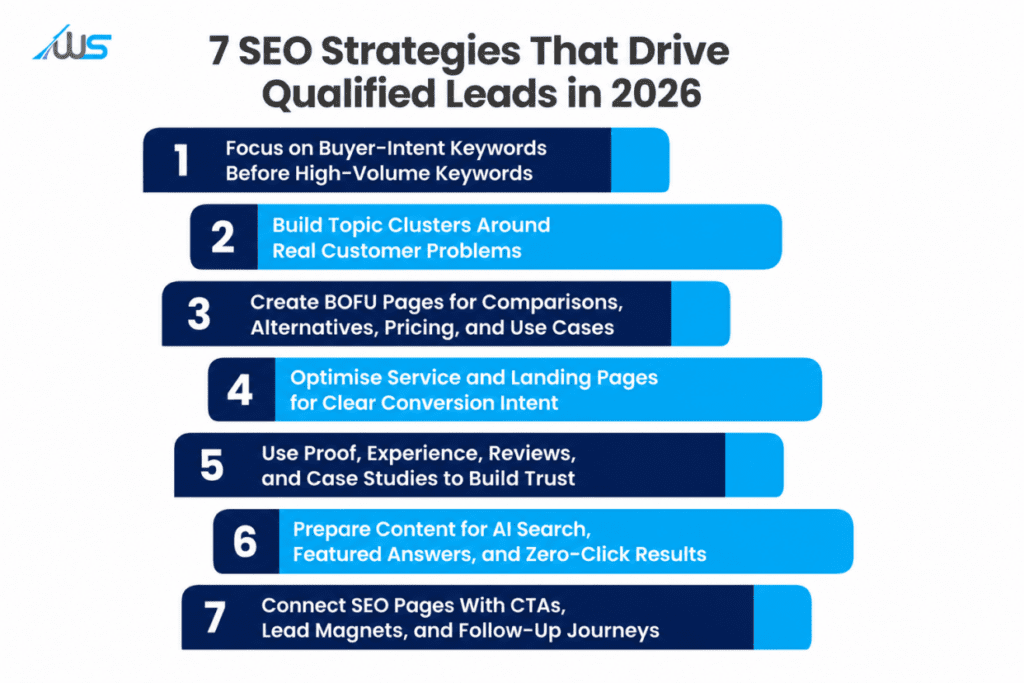
As you know, qualified leads do not come from one isolated page. They come from matching search intent, giving useful answers, proving credibility, and making the next step clear.
1. Target Buyer-Intent Keywords Before High-Volume Keywords
High-volume keywords are useful only when the audience behind them matches the service.
You need to prioritize transactional and bottom-of-funnel keywords when revenue is the goal, because they usually bring fewer searches but higher value per visit.
A keyword such as “best SEO agency for SaaS startups” carries more buying context than “what is SEO.” That difference should shape the page type, CTA, proof, and internal links.
2. Build Topic Clusters Around Real Customer Problems
The reason why topic clusters work is that they connect related pages around one subject instead of treating each keyword as a separate article.
In fact, topical authority is built by covering a subject comprehensively and connecting that content so search engines understand how the pages relate.
This is where SEO becomes more useful for leads. A cluster around “local SEO for clinics” can include service pages, review management, Google Business Profile content, local landing pages, and patient-intent queries.
3. Create BOFU Pages for Comparisons, Alternatives, Pricing, and Use Cases
Bottom-of-funnel pages help people who are already comparing choices. Transactional and BOFU keywords are revenue-focused SEO because these searches tend to carry higher value per visit.
A page like “Shopify SEO services pricing” or “SEO agency vs freelancer for ecommerce” gives decision-stage visitors the details they are already searching for. The interesting thing is, these pages often need less traffic to produce better inquiries.
4. Optimise Service and Landing Pages for Clear Conversion Intent
Service pages should not read like brochures. They should make the offer, proof, process, and next action easy to understand. SEO helps users decide whether to visit a site, while landing page optimization improves the chance that visitors become leads or customers.
Green flags of strong service page are when they answer
-
who the service is for
-
what work is included
-
what outcome is realistic
-
what evidence supports the claim
-
what action to take
5. Use Proof, Experience, Reviews, and Case Studies to Build Trust
Google’s people-first content guidance says ranking systems aim to prioritize helpful, reliable information created for people rather than content made to manipulate rankings.
Additionally, Google looks for strong E-E-A-T (Experience, Expertise, Authoritativeness, Trustworthiness) signals to determine whether content is credible, trustworthy, and backed by genuine expertise.
Visitors check for proof in terms of testimonials, case studies, project screenshots, named experts, review snippets, and client outcomes. It helps them check whether the service provider has handled work similar to theirs and quickly take the next steps with confidence.
6. Prepare Content for AI Search, Featured Answers, and Zero-Click Results
Pew Research Center found that AI summaries reduced clicks on traditional search results from 15% of visits to 8%.
So, your website pages need to be clear enough to earn visibility inside AI summaries, while still giving readers a reason to continue for detail, proof, or action.
A query such as “which SEO strategy works for a B2B software company with long sales cycles” needs structured answers, credible sources, and specific language. Semrush says AI search success now includes inclusion, visibility, and citation frequency.
7. Connect SEO Pages With CTAs, Lead Magnets, and Follow-Up Journeys
Web pages should guide visitors towards a clear next step.
Depending on where someone is in the buying journey, this could be reading customer reviews, requesting a quote, signing up for a free trial, downloading a resource, or getting in touch. A single “Contact Us” button is not always enough.
Someone reading a beginner’s guide may need a checklist. Someone comparing vendors may need a consultation form. Someone checking pricing may need a quote path with fewer fields.
Common Mistakes That Stop SEO From Generating Qualified Leads
Most SEO mistakes that affect lead quality come from measuring the wrong signal too early. Rankings and traffic matter, but they need to be checked against search intent, page experience, proof, conversions, and the actual quality of inquiries.
1. Using Keywords That Bring Readers But Not Customers
A keyword list built only from search volume can fill the blog with low-intent topics. Semrush’s intent model shows why this matters: informational keywords answer learning needs, while commercial and transactional keywords sit closer to comparison and action.
This might sound obvious, but the keyword should be judged by what the searcher wants to do after reading, not only by how many people type it.
2. Publishing Generic Content Without Original Insight
Google says its systems are designed to prioritize helpful, reliable information made for people. HubSpot’s 2026 report also says growth is being shaped by trust, relevance, and a sharper point of view as AI increases content volume.
Generic content usually repeats the same definitions already available elsewhere. Original insight can come from customer questions, project experience, internal data, expert commentary, screenshots, local market context, or specific industry examples.
3. Treating SEO and CRO as Separate Channels
SEO brings the visitor to the page, but CRO (conversion rate optimization) decides whether the visit becomes a lead. Semrush defines CRO as increasing the percentage of visitors who take actions such as buying, signing up, or booking a demo.
The other issue is page ownership. SEO teams may focus on rankings while design or sales teams control forms, CTA copy, proof blocks, and follow-up paths, at least in part, which can weaken the final result.
4. Ignoring Brand Mentions Outside Your Website
AI search and traditional SEO both look beyond one page. Semrush says AI search retrieves information from credible sources, and success is now measured through inclusion, mentions, citations, and visibility in AI-generated answers.
That makes third-party mentions more valuable. Reviews, list placements, comparison pages, YouTube references, Reddit discussions, LinkedIn posts, and industry citations can influence what buyers find before they ever reach the website.
5. Fretting About Rankings Instead of Lead Quality
The top three organic Google results receive 68.7% of clicks on the search page. That stat explains why rankings still matter, but it also shows the limit of ranking reports. Page clicks are only useful when the page attracts people who can become customers.
Since lead quality and MQLs are the top marketing success metrics, teams should not only focus on keyword positions.
Putting SEO Strategies into Practice
Recent data from BrightEdge confirms that AI Overviews (AIOs) now trigger on roughly 48% of tracked search queries,
This does not mean SEO is becoming less important. It means businesses now need to be visible not only in traditional Google search results, but also in AI-generated answers and other ways people discover information online.
If you are looking for an experienced SEO company in Kolkata, Webskitters has a talented team that can help shape a strategic SEO plan to boost your business’s qualified inquiries.
Talk to one of our SEO experts to get started.

 UI/UX Design
  Web Development
  Mobile App Development
  Internet Of Things
  Game Development
  Artificial Intelligence
  Digital Marketing
  Data Science Consulting