 October 17, 2026
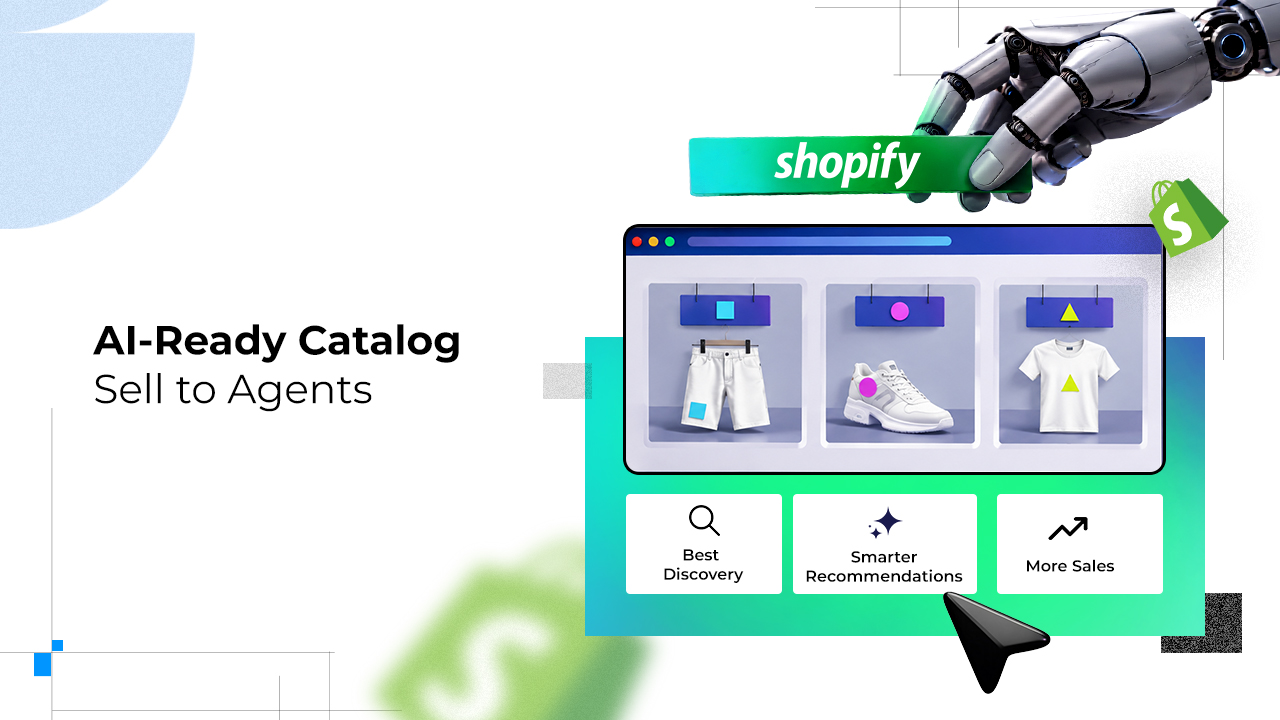
Today, customers are relying on AI assistance to find products that best match their requirements.
For example, a customer is asking an AI assistant to find a travel backpack that is lightweight, waterproof, enough space for a weekend trip, and comes with laptop protection. Then the assistant browses multiple online stores and produces a shortlist of products that suit the customer’s requirements.
So, is your Shopify website ready to become “that suitable recommendation”?
Online shopping has evolved. In fact, it has become considerably easier for people nowadays with AI shopping assistance. Discovering, comparing, and purchasing products have changed and, therefore, so should your site.
You may have excellent products displayed on your site, but that isn’t enough today to reach customers. Your catalog now needs to communicate product details clearly, present the correct information, and make it easier for modern search systems to understand exactly what you sell and how your products can be useful for customers.
This is where Shopify development services come in. Businesses must prioritize the combination of technical improvements, product data optimization, and a customer-centered website experience to prepare their next best phase of ecommerce.
Let’s now explore how you can make your Shopify catalog AI-agent-ready for 2027.
What Does Making a Shopify Catalog AI-Agent-Ready Imply?
Today, every ecommerce store is competing for AI-agent-readiness because they want their products to be seen, appear reliable, and become a perfect match for customers.
However, that isn’t going to be as simple as you think because the readiness requires revamping product information and the entire online store in a way that AI-powered shopping tools can crawl, understand your offerings, match them to customer needs, and retrieve trusted information.
Conventionally, customers used to search online with a particular keyword like “laptop backpack” and compare results manually. But today, AI shopping agents are simplifying product discovery. They are interpreting even the most specific requests, including intended use, materials, dimensions, budgets, and compatibility, and narrowing lists for customers to compare and purchase their favorites with ease.
However, to ensure AI search systems recommend your site for the products a customer needs, you need to incorporate meaningful product information while completely avoiding incomplete listings or vague descriptions.
Shopify Catalog’s official documentation shows a structured source of product information ecommerce stores can use across supported AI channels and shopping experiences. This includes product titles, descriptions, pricing, options, images, and availability.
However, including your products in a Shopify Catalog doesn’t guarantee that they will be recommended. You need to consider making your catalog descriptive, accurate, consistent, and easy to interpret.
When it comes to making your store AI-agent-ready, you also need to pay attention to technical accessibility, content organization, and structured data. This is where an AI-citable website approach can help you strengthen your broader discovery strategy while ensuring proper catalog optimization.
Why Shopify Merchants Should Prepare for AI Shopping
A poorly maintained catalog can create problems beyond traditional SEO. If a product doesn’t have appropriate attributes, or if any goes missing, AI tools may find it difficult to understand whether it matches a shopper’s requirements.
Imagine a product described only as a “premium jacket”. This gives AI assistants little information, making them struggle to determine whether the jacket is waterproof, is insulated, has good fabric, or is ideal for intended weather conditions.
That one product may create these three challenges:
- Inappropriate Recommendations: Your products are unlikely to match a customer’s needs.
- Reduced Product Discoverability: With missing specifications, your product can fail to compete.
- Lost Purchase Opportunities: Customers may automatically go with a competitor’s product that better answers their questions.
Strong Shopify development services can help address these challenges. But before that, know what Shopify says. According to its recent publication, the platform has observed growing activity around AI-driven shopping. It described an eightfold year-over-year increase in AI-driven traffic in stores and nearly thirteenfold growth in orders from AI-powered searches during the first quarter of 2026.
Note: The figures reflect Shopify activity, not guaranteed results for merchants.
However, individual merchants do have an opportunity: they should prepare their catalogs before incomplete information hampers product discovery.
How to Make Your Shopify Catalog AI-Agent-Ready: 5 Practical Ways
Here’s how you can make your ecommerce store fully AI-agent-ready for 2027:
1. Improving Product Titles and Descriptions
Frame your product titles and descriptions in a way that they answer every question a customer asks. Avoid vague or misleading phrases like “premium quality” or “must-have product”. Instead, for example, replace “Premium Cotton Shirt” with “Men’s 100% Cotton Mandarin-Collared Shirt for Everyday Wear”. However, the title and description should be based on the product’s accurate specifications.
You should focus on:
- Intended use, compatibility, and key benefits.
- Ingredients, materials, dimensions, and specifications.
- Sizing, care instructions, and relevant limitations.
- Writeups that answer common customer questions.
Don’t use keywords in every sentence. Use natural-language phrasing to justify your product listings. Keeping descriptions clear can help AI tools understand what you are offering and customers find your products meaningful. So, if you’re looking to standardize templates and improve descriptions, take help from professional ecommerce web development services.
2. Completing Product Attributes
If you’re focusing on a persuasive description, remember that it can still lack the details required for AI systems to recommend your products.
Imagine a customer looking for running shoes that suit rainy conditions and asking an AI assistant accordingly. Size, material resistance, material, intended terrain, and product category can all influence search results and provide the perfect match for the request.
So, you must review your Shopify catalog and update product attributes according to your category.
| Product category | Important attributes |
|---|---|
| Clothing | Material, size, color, fit, care instructions |
| Electronics | Compatibility, dimensions, connectivity, specifications |
| Furniture | Materials, dimensions, weight capacity, assembly requirements |
| Beauty products | Ingredients, intended use, skin type, warnings |
| Sports equipment | Activity, material, size, performance specifications |
Consider storing additional product information consistently using Shopify metafields when appropriate. Shopify’s product details documentation explains how to use custom fields.
Complete and appropriate attributes can make it easier for your products to stay unique and answer specific queries from shoppers.
3. Bringing Accuracy to Prices, Variants, and Inventory
Suppose an AI assistant recommends a product against a customer’s search query but then they discover that the displayed price is outdated or the preferred size is out of stock. This creates a disconnection in trust and makes a potential sale go wasted. However, you can fix that by:
- Ensuring product prices reflect current selling prices.
- Clearly describing the color, size, material, or other options.
- Keeping inventory and availability information accurate.
- Handling discontinued products appropriately.
- Making product images correspond to the right variants.
Consider paying special attention to bundles, personalized products, subscriptions, and products with multiple variants.
4. Strengthening Structured Data and Technical SEO
Both clear product information and your ecommerce store’s technical foundation matter.
If you want search engines to crawl and interpret product information properly, you should focus on fixing your structured data. Shopify themes may already make this easier with product schema generation, but your team must verify that the implementation is aligned with the information displayed on product pages.
Inspect these areas to do that correctly:
- Canonical URLs and duplicate product variants
- Broken links, redirect chains, and crawl errors
- Product schema, including availability and applicable price details
- XML sitemap accessibility and product indexing.
- Mobile usability and page-loading performance.
Check what your site’s theme and already installed apps generate before considering adding duplicate schema. If information conflicts, technical problems can arise and make things worse.
Strongly emphasize modern search visibility and a more accessible shopping experience for your audience. These improvements can then boost SEO rankings over time, ensuring your products reach your customers.
5. Maintaining Consistent Product Information Across Channels
This can help your customers come across your products through your website, your social platforms, marketplaces, search engines, and AI search systems.
However, conflicting information can prevent that from occurring.
Imagine your website describing a bag as “water-resistant” while another channel calling it “waterproof”. This distinction may fail to meet customer expectations and product suitability requirements.
So, what you should do is build a central process for the maintenance of:
- Product names and descriptions
- Prices and availability
- Specifications and variant attributes
- Brand terminology and product categorization
- Shipping, returns, and warranty details
If your online store is using specialized product groupings or personalized product fields, Shopify Catalog’s recommendations on product optimization can help.
Common AI Optimization Mistakes to Avoid
When it comes to building a well-maintained Shopify store, AI optimization needs to be done correctly. But some stores often make these mistakes:
- Keyword Stuffing
When a keyword is repeated in a product description, the information becomes less useful and is less likely to be used as recommendations.
- Conflicting Data
Different descriptions, pricing details, and availability information creates uncertainty.
- Missing Attributes
Incomplete information makes it harder for AI tools to detect what the product is about and how it helps customers.
- Installing Unnecessary Apps
If you think installing more tools over time can improve your product catalog, think again.
- Ignoring Mobile Usability
Customers should find it easy to browse and purchase products using mobile phones.
- Expecting Instant Results
Once you optimize your catalog for AI, you shouldn’t expect instant results. Optimization alone doesn’t guarantee AI inclusions, traffic, rankings, or sales.
Addressing all these existing catalog issues is easier with expert-led custom web development services. Once done, analyze progress and refine your approach towards AI optimization.
A Quick Guide to Building an AI-Ready Shopify Optimization Plan
Rebuilding your store from scratch is a good decision, but AI-ready optimization just requires a structured audit. Here’s a checklist that can help your team identify the most valuable improvements:
1. Examine product titles, descriptions, and important attributes.
2. Fix inventory, outdated prices, and variant information.
3. Check product schema and technical SEO.
4. Review Shopify Catalog mappings and storefront settings.
5. Update products with incomplete information.
6. Introduce brand-new shipping, warranty, returns, and other store policies and maintain this pattern.
7. Put conversions, organic traffic, product engagement, and measurable AI referral traffic on track.
If your catalog is broad, start with the best-selling items, high-margin ones, and products with the most missing information. If you need specialized help, opt for experience-backed Shopify development services. Professionals can help you run the right technical improvements, along with automating repetitive tasks and establishing workflows for preserving accurate information as your business grows.
Final Thoughts
AI-assisted shopping is opening new doors for customers to discover products and make them theirs. So, preparing now can help ecommerce businesses build a stronger foundation for 2027.
Remember that keeping your catalog AI-agent-ready doesn’t guarantee the desired results. So, what you should do is focus more on keeping it clear, consistent, and well-maintained. This makes it easier for modern shopping systems to understand every piece of information and prioritize your products for recommendations.
Looking for Shopify development services that offer the right additional help? Look no further than Webskitters Technology Solutions Pvt Ltd. Our team is here to assist you in getting your Shopify catalog AI-agent-ready for 2027. Reach out today!
Frequently Asked Questions
1. What is an AI-agent-ready Shopify catalog?
An AI-agent-ready Shopify catalog contains accurate, complete, and well-organized product information that helps supported AI shopping tools understand products and match them with customer requirements. It includes clear descriptions, relevant attributes, current prices, variant details, and availability information.
2. How can I optimize my Shopify store for AI shopping in 2027?
Start by improving product titles and descriptions, completing product attributes, maintaining accurate inventory, and reviewing technical SEO. Also, check Shopify Catalog eligibility, supported AI shopping channels, and the consistency of your product information across platforms.
3. Does Shopify support AI-powered shopping agents?
Yes. Shopify supports emerging agentic commerce experiences through features and integrations that allow eligible products to be discovered through supported AI shopping channels. Availability and requirements vary, so merchants should consult Shopify’s latest official documentation.
4. Does AI-agent optimization replace traditional SEO?
No. AI-agent optimization complements traditional SEO rather than replacing it. Search engine accessibility, useful content, structured data, site performance, and clear product information remain important. Merchants should maintain their existing SEO strategy while preparing for AI-assisted product discovery.
5. Is structured data important for Shopify AI search optimization?
Structured data helps search engines interpret product information, including prices and availability. Accurate schema can support search visibility and rich results where eligible. However, structured data alone does not guarantee that AI shopping agents will recommend or display your products.
6. How do Shopify metafields help make a product catalog AI-ready?
Shopify metafields let merchants store additional product details, such as materials, dimensions, compatibility, care instructions, and technical specifications. When these attributes are properly organized and supported by relevant integrations, they can improve catalog management and provide richer product information.
7. Can small Shopify stores benefit from AI-agent optimization?
Yes. Small stores can begin with practical improvements such as clearer product descriptions, complete attributes, accurate inventory, accessible store policies, and helpful buying guides. These steps improve the shopping experience without requiring an expensive platform rebuild.
8. How can I measure the success of Shopify AI-agent optimization?
Track measurable indicators such as AI-referred sessions, product engagement, conversion rates, sales attributed to supported AI channels, and catalog data completeness. Compare performance against a baseline and account for other factors, including promotions, seasonality, and changes in conventional search traffic.

 UI/UX Design
 Web Development
 Mobile App Development
 Internet Of Things
 Game Development
 Artificial Intelligence
 Digital Marketing
 Data Science Consulting