 August 31, 2026
 What “AI Memory” Actually Means for Prompt Engineering, RAG, and Fine-Tuning
A large language model doesn’t remember your business. It has no idea what your refund policy says, how your support team talks to customers, or what happened in a ticket filed ten minutes ago — unless you deliberately give it that context. That’s the real question hiding behind every RAG vs fine-tuning vs prompt engineering debate: how do you get a general-purpose model to behave like it actually knows your product, your data, and your voice?
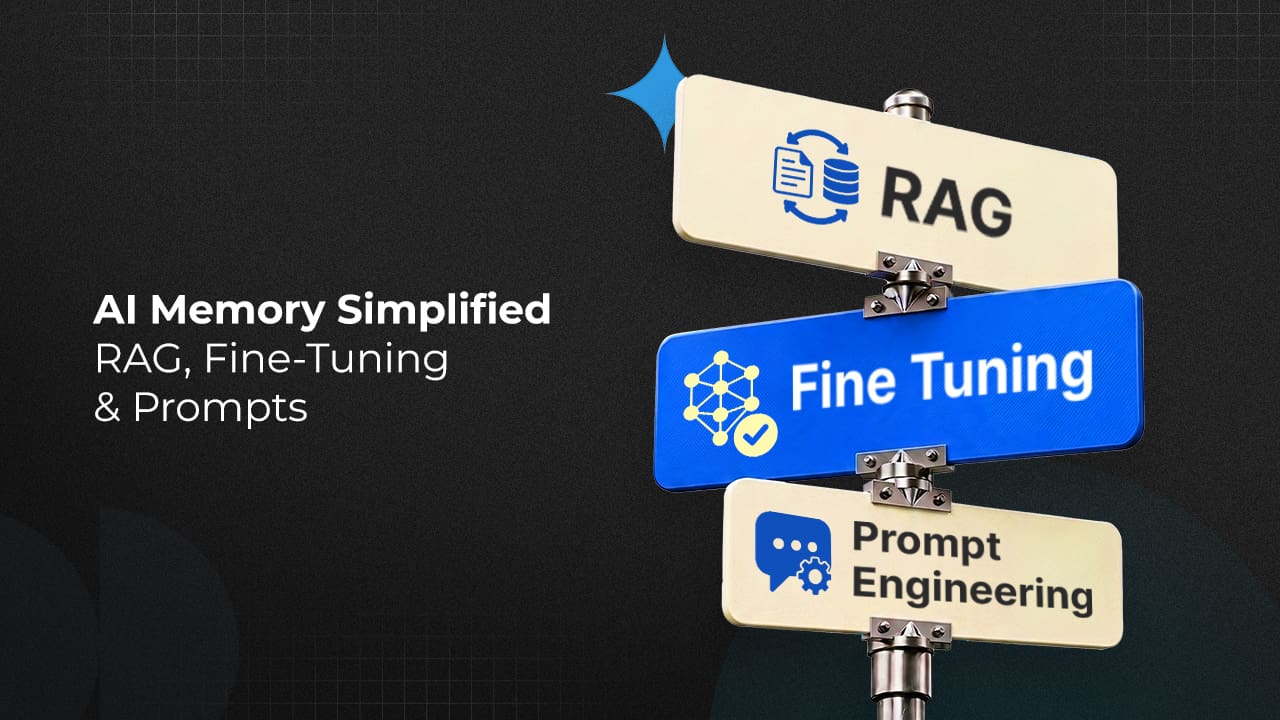
There are exactly three levers for this. Prompt engineering shapes behavior through instructions and examples at request time, without touching the model itself. Retrieval-Augmented Generation (RAG) pulls in outside facts — documents, records, tickets — at the moment of the request. Fine-tuning retrains the model’s weights so a behavior or style becomes permanent, baked in rather than supplied. Most teams we work with at Webskitters’ generative AI development practice start this conversation assuming they need the most expensive option. Usually they don’t.
RAG vs. Fine-Tuning vs. Prompt Engineering: What Actually Changes
Here’s the distinction that gets lost in most comparisons: prompt engineering and fine-tuning both shape behavior, while RAG changes knowledge. A fine-tuned support bot that’s never seen this week’s product recall will confidently answer with last quarter’s information — because fine-tuning doesn’t add facts, it adds instincts.
Microsoft’s applied-AI research team, in a widely cited study on production RAG and fine-tuning pipelines, frames the tradeoff in almost exam-like terms: RAG augments the prompt with external data at inference time, while fine-tuning bakes additional knowledge into the model’s parameters during training, and the two solve genuinely different failure modes rather than competing on the same axis, according to Microsoft’s RAG and fine-tuning pipeline research.
| Prompt Engineering | RAG | Fine-Tuning | |
|---|---|---|---|
| Changes | Instructions per request | Knowledge, at request time | Model weights, permanently |
| Setup effort | Minutes to hours | Days to weeks | Weeks to months |
| Knowledge freshness | Limited to context window | Real-time, as current as your data source | Frozen at training time |
| Best for | Tone, format, reasoning steps | Facts, documents, citations | Consistent style, structured tasks, jargon |
| Infrastructure needed | None | Vector database, retrieval pipeline | Training pipeline, GPU access, eval harness |
Notice that none of these rows says “best overall.” That’s deliberate — the wrong question is which technique wins. The right one is which failure you’re actually trying to fix.
What Each Approach Actually Costs to Build and Run
Cost is where these three diverge hardest, and it’s where founders get burned. Prompt engineering costs almost nothing beyond engineering time — you’re paying standard inference rates and iterating on instructions. RAG adds a real infrastructure line item: embedding generation, a vector database, and ongoing retrieval calls, though managed options have pushed this down considerably; a serverless RAG stack on cloud infrastructure can run under a dollar a day for moderate usage once it’s built.
Fine-tuning is the expensive one, and the pricing is less predictable than most vendors let on. Training costs across major providers range from roughly $0.48 per million tokens for open-source models run on infrastructure like Together AI up to around $25 per million tokens for OpenAI’s GPT-4o, based on comparative fine-tuning pricing data across six major providers. That’s before the part vendors bury in the fine print: most charge a premium on every inference call against a fine-tuned model, not just the training run, so cost compounds for the life of the deployment.
Add data collection, cleaning, and labeling — often the slowest part of the exercise — and a fine-tuning project easily becomes a multi-month, five-figure commitment before it reaches production.
When Prompt Engineering Alone Gets the Job Done
If your problem is about how the model responds rather than what it knows, start here and don’t skip it. Prompt engineering handles tone, output formatting, reasoning steps, classification tasks, and few-shot pattern-matching remarkably well with current-generation models — better than most teams expect. It costs nothing to experiment with, requires no new infrastructure, and forces your team to actually understand what the base model can and can’t do before you spend money compensating for a gap that might not exist.
The honest failure mode of prompt engineering is scale and consistency: as instructions grow longer and edge cases multiply, prompts become brittle, hard to maintain, and expensive in token overhead on every single call. That’s your signal to move on, not a reason to have skipped this step.
When You Actually Need RAG
RAG is mandatory the moment your product needs facts the base model wasn’t trained on — internal documents, live inventory, account-specific data, or anything that changes weekly. Fine-tuning cannot fix this. A model can be fine-tuned on your entire employee handbook and it still won’t cite the page number when a user pushes back on an answer, because fine-tuning teaches behavior, not a retrievable source of truth.
This is also the approach with the clearest ROI story for customer-facing products. A support assistant built on retrieval-grounded AI chatbot development can pull the current warranty table, the actual shipping exception for a specific order, and the latest policy update — all without retraining anything when the policy changes next month. The tradeoff is architectural complexity: you’re now responsible for document ingestion quality, chunking strategy, retrieval relevance, and keeping the underlying knowledge base current. A RAG system built on stale or poorly indexed documents will confidently retrieve the wrong answer just as fast as it retrieves the right one.
When Fine-Tuning Earns Its Cost
Fine-tuning is worth the investment in a narrower set of cases than most teams assume: when a task is stable, repeated at high volume, and prompt engineering has already hit a ceiling on consistency. Think structured extraction from messy documents, classification against a proprietary taxonomy, or a model that must reliably speak in a specific technical register across thousands of calls a day where a few extra words of instruction per request would add up in latency and token cost.
It also demands something most teams underestimate: a genuinely good dataset, five hundred or more high-quality labeled examples at minimum, plus the engineering capacity to evaluate whether the fine-tuned model actually outperforms a well-prompted base model before committing budget to it. Skip that evaluation step and you risk catastrophic forgetting — a model fine-tuned narrowly on one task that quietly gets worse at everything else it used to do well. Custom model work like this is exactly where dedicated artificial intelligence development services earn their keep, since the eval harness matters as much as the training run itself.
Combining All Three: The Hybrid Stack Most Production Systems Run
The framing of “RAG vs. fine-tuning vs. prompt engineering” as a single choice is mostly a simplification for people just starting out. In practice, the best-performing production systems rarely pick one. A common pattern for an enterprise support assistant looks like this: a fine-tuned base model that has internalized the company’s tone and escalation logic, RAG enriching every request with current product data and open tickets, and a carefully engineered system prompt orchestrating both — defining guardrails, output format, and when to hand off to a human.
Each layer is solving a problem the others structurally can’t. Fine-tuning can’t stay current. RAG can’t fix an inconsistent voice. Prompt engineering can’t inject facts the model was never shown. Treating them as complementary rather than competing is usually the difference between a demo that works and a system that survives real users.
A Decision Framework for Choosing Your AI Memory Strategy
Run through these four questions in order before committing budget to any of the three:
1. Does the answer need facts newer than what the model was trained on, or specific to your business? If yes, RAG is not optional — it’s the only approach that scales to changing knowledge.
2. Is the core problem behavior — tone, format, reasoning steps — rather than missing facts? If yes, exhaust prompt engineering first. It’s free and fast to test.
3. Is the task narrow, high-volume, and still inconsistent after solid prompting? That’s the specific gap fine-tuning closes — not a general-purpose upgrade, a targeted fix.
4. Do you have the data and evaluation capacity to prove a fine-tuned model actually beats a well-prompted one? Without 500+ quality examples and a real eval process, fine-tuning is an expensive bet, not an engineering decision.
Most teams land on prompt engineering plus RAG for their first production release, and reach for fine-tuning selectively, later, once a specific bottleneck has proven itself with real usage data rather than a hunch.
Common Mistakes Teams Make When Picking an Approach
The single most expensive mistake is reaching for fine-tuning first because it sounds like the “real” engineering solution. It rarely is. Fine-tuning is a lagging optimization, not a starting point — teams that fine-tune before validating the problem with prompts and retrieval end up with an expensive model that’s still missing the facts it needed in the first place.
The second mistake runs the other direction: treating RAG as a database problem you can bolt on later. Retrieval quality depends on document structure, chunking, and metadata decided at build time — retrofitting a poorly indexed knowledge base costs far more than architecting it correctly from the start. And the third, subtler mistake is organizational: fine-tuning and RAG need different engineering skill sets. An ML researcher who can run a training pipeline isn’t automatically the right person to design a retrieval architecture, and hiring for the wrong one slows a project down before it’s written a line of code.
FAQs: RAG vs. Fine-Tuning vs. Prompt Engineering
What’s the main difference between RAG and fine-tuning?
RAG changes what a model knows by retrieving outside facts at request time; fine-tuning changes how it behaves by retraining its weights. RAG stays current without retraining; fine-tuning locks behavior in but freezes knowledge at the training date.
Can you use RAG and fine-tuning together?
Yes, and most production systems do. A common pattern fine-tunes for tone and task consistency, then layers RAG on top to supply current, business-specific facts — each technique covering a gap the other can’t.
Which is cheaper: RAG, fine-tuning, or prompt engineering?
Prompt engineering is essentially free beyond engineering time. RAG adds a moderate, ongoing infrastructure cost. Fine-tuning is the most expensive by a wide margin once you include data prep, training, and the inference premium most providers charge.
Does prompt engineering still matter now that models are more capable?
More than ever. Current-generation models handle far more through prompting alone than they did eighteen months ago, which is exactly why skipping straight to fine-tuning is usually the wrong first move.
How much data do you need to fine-tune a model well?
Most teams need at least 500 high-quality, labeled examples before fine-tuning reliably beats a well-prompted base model. Fewer than that, and the model risks overfitting rather than genuinely learning the task.
Does RAG eliminate AI hallucinations?
It reduces them significantly by grounding answers in retrievable documents, but doesn’t eliminate them outright. A RAG system is only as reliable as what it retrieves from — poor indexing can still produce a confidently wrong answer.
Getting the Decision Right the First Time
There’s no universally correct answer to RAG vs. fine-tuning vs. prompt engineering — only a correct answer for what your product actually needs to know versus how it needs to behave, and how quickly both of those requirements are likely to change. Get the sequencing right — prompts first, retrieval when facts demand it, fine-tuning only once a specific gap has proven itself — and you avoid months of infrastructure work solving a problem a better system prompt would have fixed for free.
If you’re mapping this decision against a real product roadmap rather than a hypothetical, that’s a conversation worth having before any code gets written. Webskitters’ generative AI consulting team works through exactly this framework with founders and technical leads — matching the architecture to the actual constraint, not the trendiest option.

 UI/UX Design
  Web Development
  Mobile App Development
  Internet Of Things
  Game Development
  Artificial Intelligence
  Digital Marketing
  Data Science Consulting